
 RSS Feed
 by Calculated Risk on 7/19/2012 10:00:00 AM
Thursday, July 19, 2012
Existing Home Sales in June: 4.37 million SAAR, 6.6 months of supply
The NAR reports: June Existing-Home Prices Rise Again, Sales Down with Constrained Supply
Total existing-home sales, which are completed transactions that include single-family homes, townhomes, condominiums and co-ops, declined 5.4 percent to a seasonally adjusted annual rate of 4.37 million in June from an upwardly revised 4.62 million in May, but are 4.5 percent higher than the 4.18 million-unit level in June 2011.
...
Total housing inventory at the end June fell another 3.2 percent to 2.39 million existing homes available for sale, which represents a 6.6-month supply at the current sales pace, up from a 6.4-month supply in May. Listed inventory is 24.4 percent below a year ago when there was a 9.1-month supply.
 Click on graph for larger image.
This graph shows existing home sales, on a Seasonally Adjusted Annual Rate (SAAR) basis since 1993.
Sales in June 2012 (4.37 million SAAR) were 5.4% lower than last month, and were 4.5% above the June 2011 rate.
The second graph shows nationwide inventory for existing homes.
 According to the NAR, inventory declined to 2.39 million in June from the downwardly revised 2.47 million in May (revised down from 2.49 million). Inventory is not seasonally adjusted, and usually inventory increases from the seasonal lows in December and January to the seasonal high in mid-summer.
The last graph shows the year-over-year (YoY) change in reported existing home inventory and months-of-supply. Since inventory is not seasonally adjusted, it really helps to look at the YoY change. Note: Months-of-supply is based on the seasonally adjusted sales and not seasonally adjusted inventory.
 Inventory decreased 24.4% year-over-year in June from June 2011. This is the sixteenth consecutive month with a YoY decrease in inventory, and the largest year-over-year decline reported.
Months of supply increased to 6.6 months in June.
This was below expectations of sales of 4.65 million. However, as I've noted before, those focusing on sales of existing homes, looking for a recovery for housing, are looking at the wrong number. For existing home sales, the key number is inventory - and the sharp year-over-year decline in inventory is a positive for housing. I'll have more later ...
Weekly Initial Unemployment Claims increase to 386,000
by Calculated Risk on 7/19/2012 08:37:00 AM
The DOL reports:
In the week ending July 14, the advance figure for seasonally adjusted initial claims was 386,000, an increase of 34,000 from the previous week's revised figure of 352,000. The 4-week moving average was 375,500, a decrease of 1,500 from the previous week's revised average of 377,000.
The following graph shows the 4-week moving average of weekly claims since January 2000.
 Click on graph for larger image.
The dashed line on the graph is the current 4-week average. The four-week average of weekly unemployment claims declined to 375,500.
The sharp decline last week due to onetime factors, and some increase was expected.
And here is a long term graph of weekly claims:
 This was well above the consensus forecast of 365,000 and suggests ongoing weakness in the labor market.
Wednesday, July 18, 2012
Thursday: Existing Home Sales, Philly Fed, Unemployment Claims
by Calculated Risk on 7/18/2012 09:31:00 PM
Existing home sales for June is the key release on Thursday. Most of the focus will be on sales, but the key numbers are inventory and months-of-supply.
• At 8:30 AM ET, the initial weekly unemployment claims report will be released. The consensus is for claims to increase to 365 thousand.
• At 10:00 AM, Existing Home Sales for June from the National Association of Realtors (NAR). The consensus is for sales of 4.65 million on seasonally adjusted annual rate (SAAR) basis, up from 4.55 million in May.
• Also at 10:00 AM, Philly Fed Survey for July will be released. This survey really surprised to the downside in June, and the consensus is for a reading of -8.0, up from -16.6 last month (below zero indicates contraction).
• Also at 10:00 AM, the Conference Board Leading Indicators for June will be released. The consensus is for a 0.1% decrease in this index.
Earlier:
• Housing Starts increased to 760 thousand in June, Highest since October 2008
• Starts and Completions: Multi-family and Single Family
• August 1st QE3 Departure Date?
Starts and Completions: Multi-family and Single Family
by Calculated Risk on 7/18/2012 05:12:00 PM
Halfway through 2012, single family starts are on pace for over 500 thousand this year, and total starts are on pace for about 730 thousand. That is above the forecasts for most analysts (however Lawler and the NAHB were close).
Here is an update to the graph comparing multi-family starts and completions. Since it usually takes over a year on average to complete a multi-family project, there is a lag between multi-family starts and completions. Completions are important because that is new supply added to the market, and starts are important because that is future new supply (units under construction is also important for employment).
These graphs use a 12 month rolling total for NSA starts and completions.
 Click on graph for larger image.
The blue line is for multifamily starts and the red line is for multifamily completions.
The rolling 12 month total for starts (blue line) has been increasing steadily, and completions (red line) is lagging behind - but completions will follow starts up over the course of the year (completions lag starts by about 12 months).
This means there will be an increase in multi-family deliveries next year.
 The second graph shows single family starts and completions. It usually only takes about 6 months between starting a single family home and completion - so the lines are much closer. The blue line is for single family starts and the red line is for single family completions.
For the fifth consecutive month, the rolling 12 month total for starts has been above completions - that usually only happens after housing has bottomed.
Earlier on housing starts:
• Housing Starts increased to 760 thousand in June, Highest since October 2008
Fed's Beige Book: Economic activity increased at "modest to moderate" pace, Residential real estate "largely positive"
by Calculated Risk on 7/18/2012 02:00:00 PM
Reports from most of the twelve Federal Reserve Districts indicated that overall economic activity continued to expand at a modest to moderate pace in June and early July.This is a downgrade from the previous beige book that reported "moderate" growth.
And on real estate:
Reports on residential housing markets remained largely positive. Sales were characterized as improving in Philadelphia, New York, Richmond, Chicago, St. Louis, and Minneapolis, while home sales increased in Boston, Cleveland, Atlanta, St. Louis, Minneapolis, Kansas City, Dallas, and San Francisco."Prepared at the Federal Reserve Bank of Atlanta and based on information collected before July 9, 2012."
...
Most Districts reported declines in home inventories. Homes prices have begun to stabilize in some markets and price increases were noted in select markets. Boston and Atlanta noted that appraisals were coming in below market prices.
...
Rental markets continued to strengthen by most accounts.
...
Recent activity in commercial real estate markets has been mixed. Modest improvements were noted in Boston, Atlanta, and St. Louis and demand strengthened in the San Francisco District. Softer conditions were reported in the New York and Richmond Districts, while demand held steady in the Philadelphia and Dallas Districts. Nonresidential construction activity varied as well.
More sluggish growth, but still "modest to moderate". And a few positive comments on residential real estate ...
August 1st QE3 Departure Date?
by Calculated Risk on 7/18/2012 11:47:00 AM
There is quite a bit of discussion on when (not if) the Fed will embark on QE3. As an example, from Goldman Sachs yesterday:
While we think that a modest easing step is a strong possibility at the August or September meeting, we suspect that a large move is more likely to come after the election or in early 2013, barring rapid further deterioration in the already-cautious near term Fed economic outlook.And from Merrill Lynch this morning:
We expect that, as the data continue to soften, the Fed will undershoot its own forecasts and thus respond with further easing. We expect the Fed to push out its forward guidance until at least mid-2015, perhaps at the August 1 FOMC meeting, and to launch a $500bn QE3 asset purchase plan by the September 13 meeting.Although the date is uncertain, I think there is a strong possibility that the Fed will launch QE3 on August 1st.
First, I think Bernanke paved the way for QE3 at the press conference on June 20th. Before embarking on previous rounds of QE, Bernanke always outlined the reasons - and I thought he made it clear that if the economy didn't improve, more accommodation was coming. And, if anything, the data has been worse since the last meeting. However there has only been a limited amount of data (Q2 GDP will be released next week), and some participants might argue they need additional data before supporting QE3.
Second, two of the key undecided voting members of the FOMC are clearly moving closer to supporting QE3. Last week Atlanta Fed President Dennis Lockhart came close to advocating QE3. Although Lockhart weighed both sides of each issue in his speech, he concluded: 1) the risks of QE3 are "manageable", 2) QE3 will be modestly effective, and 3) his earlier forecast is becoming "untenable" and that means he will support more accommodation if the recent weak data continues.
And yesterday, Cleveland Fed President Sandra Pianalto said more easing could be warranted.
My outlook calls for the pace of growth to pick up over the course of this year and into 2013 as the headwinds holding back the recovery gradually abate. I also expect inflation to remain close to 2 percent. If the expansion were to continue to lose momentum, and inflation threatened to run persistently below 2 percent, additional policy action could be warranted.I expect Pianalto will revise down her outlook over the next couple of weeks.
Third, it appears some key members of the FOMC (Yellen, Dudley, Williams) are all pushing harder for QE now. San Francisco Fed President John Williams is definitely being more aggressive, from July 9th:
We are falling short on both our employment and price stability mandates, and I expect that we will make only very limited progress toward these goals over the next year. ... If further action is called for, the most effective tool would be additional purchases of longer-maturity securities, including agency mortgage-backed securities. ... At the Fed, we take our dual mandate with the utmost seriousness. ... We stand ready to do what is necessary to attain our goals of maximum employment and price stability.By my count, if Bernanke decides that QE3 is appropriate, he will have 10 or 11 votes on August 1st. Maybe the FOMC will wait for more data, but I think QE3 is likely very soon.
AIA: Architecture Billings Index shows "drop in design activity" in June
by Calculated Risk on 7/18/2012 10:41:00 AM
Note: This index is a leading indicator primarily for new Commercial Real Estate (CRE) investment.
From AIA: Weak Market Conditions Persist According to Architecture Billings Index
The Architecture Billings Index (ABI) saw more poor conditions last month, indicating a drop in design activity at U.S. architecture firms, and suggesting upcoming weakness in spending on nonresidential construction projects. As a leading economic indicator of construction activity, the ABI reflects the approximate nine to twelve month lag time between architecture billings and construction spending. The American Institute of Architects (AIA) reported the June ABI score was 45.9, nearly identical to the mark of 45.8 in May. This score reflects a decrease in demand for design services (any score above 50 indicates an increase in billings). The new projects inquiry index was 54.4, up slightly from mark of 54.0 the previous month.
“The downturn in design activity that began in April and accelerated in May has continued into June, likely extending the weak market conditions we’ve seen in nonresidential building activity ,” said AIA Chief Economist, Kermit Baker, PhD, Hon. AIA. “While not all firms are experiencing negative conditions, a large share is still coping with a sluggish and erratic marketplace.”
 Click on graph for larger image.
This graph shows the Architecture Billings Index since 1996. The index was at 45.9 in June, up slightly from May. Anything below 50 indicates contraction in demand for architects' services.
Note: This includes commercial and industrial facilities like hotels and office buildings, multi-family residential, as well as schools, hospitals and other institutions.
According to the AIA, there is an "approximate nine to twelve month lag time between architecture billings and construction spending" on non-residential construction. This suggests further weakness in CRE investment later this year and into next year (it will be some time before investment in offices and malls increases).
Housing Starts increased to 760 thousand in June, Highest since October 2008
by Calculated Risk on 7/18/2012 08:30:00 AM
From the Census Bureau: Permits, Starts and Completions
Housing Starts:
Privately-owned housing starts in June were at a seasonally adjusted annual rate of 760,000. This is 6.9 percent above the revised May estimate of 711,000 and is 23.6 percent above the June 2011 rate of 615,000.
Single-family housing starts in June were at a rate of 539,000; this is 4.7 percent above the revised May figure of 515,000. The June rate for units in buildings with five units or more was 213,000.
Building Permits:
Privately-owned housing units authorized by building permits in June were at a seasonally adjusted annual rate of 755,000. This is 3.7 percent below the revised May rate of 784,000, but is 19.3 percent above the June 2011 estimate of 633,000.
Single-family authorizations in June were at a rate of 493,000; this is 0.6 percent above the revised May figure of 490,000. Authorizations of units in buildings with five units or more were at a rate of 241,000 in June.
 Click on graph for larger image.
Total housing starts were at 760 thousand (SAAR) in June, up 6.9% from the revised May rate of 711 thousand (SAAR). Note that May was revised up from 708 thousand. April was revised up slightly too.
Single-family starts increased 4.7% to 539 thousand in June.
The second graph shows total and single unit starts since 1968.
 This shows the huge collapse following the housing bubble, and that total housing starts have been increasing lately after moving sideways for about two years and a half years.
 Total starts are up 59% from the bottom start rate, and single family starts are up 53% from the low.
This was above expectations of 745 thousand starts in June. This is another fairly strong housing report.
MBA: "Record Low Mortgage Rates Lead to Jump in Refinance Activity"
by Calculated Risk on 7/18/2012 07:04:00 AM
From the MBA: Record Low Mortgage Rates Lead to Jump in Refinance Activity
The Refinance Index increased 22 percent from the previous week and is at the highest level since mid-June. The seasonally adjusted Purchase Index decreased 0.1 percent from one week earlier.
“Refinance application volume increased last week to near peak levels for the year as mortgage rates dropped to a new low, driven down by growing concerns about the health of the US economy,” said Mike Fratantoni, MBA’s Vice President of Research and Economics. “Applications for HARP refinance loans accounted for 24 percent of refinance activity last week, in line with the HARP share for the past few weeks.”
The average contract interest rate for 30-year fixed-rate mortgages with conforming loan balances ($417,500 or less) decreased to 3.74 percent, the lowest rate in the history of the survey, from 3.79 percent, with points increasing to 0.45 from 0.36 (including the origination fee) for 80 percent loan-to-value ratio (LTV) loans.
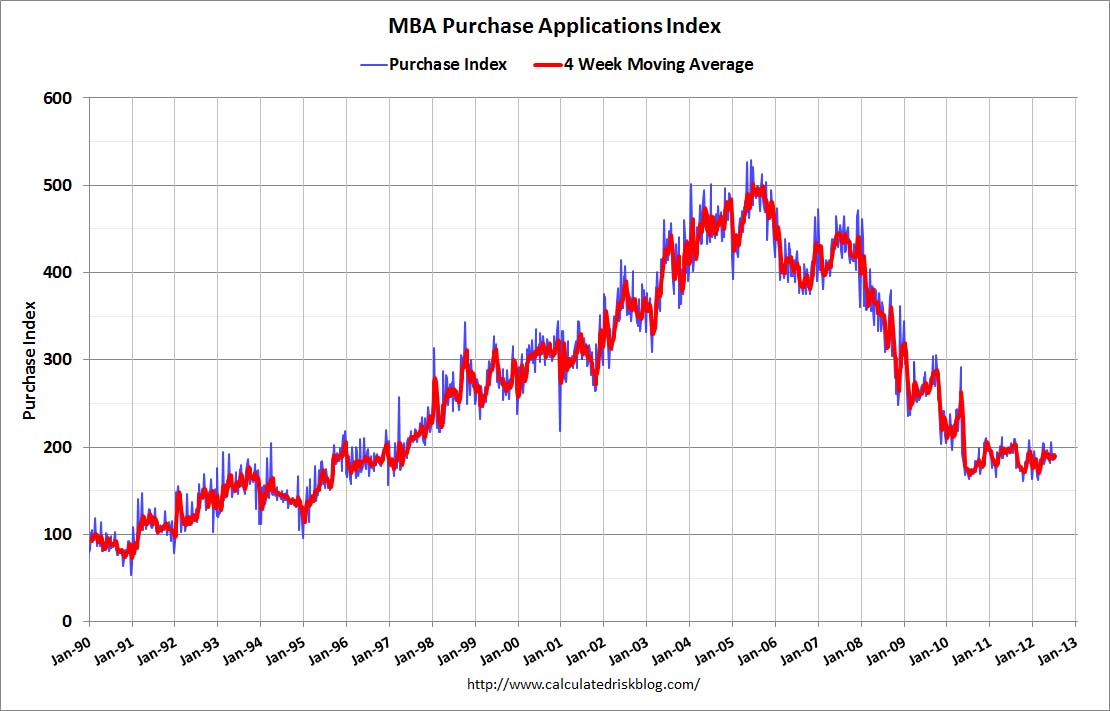 Click on graph for larger image.
The first graph shows the purchase index, and the purchase index is mostly moving sideways over the last two years - but has been moving a little recently.
The second graph shows the refinance index.
 This index is back to the high for the year.
Some of the increase in the refinance index is related to HARP (HARP activity has picked up this year), but most of this activity is related to the record low mortgage rates.
Tuesday, July 17, 2012
Wednesday: Housing Starts, Beige Book, more Bernanke
by Calculated Risk on 7/17/2012 10:01:00 PM
Wednesday will be another busy day for economic data, but first from Binyamin Appelbaum at the NY Times: Cautious on Growth, Bernanke Offers No Hint of New Action
The Federal Reserve chairman, Ben S. Bernanke, said Tuesday that the Fed was seeking greater clarity about the health of the recovery, suggesting that officials were not ready to approve another round of stimulus.• At 7:00 AM AM ET, the Mortgage Bankers Association (MBA) will release the mortgage purchase applications index.
...
Rather than committing to new steps, Mr. Bernanke told the Senate Banking Committee that the decision would turn on the judgment of Fed officials about the pace of job growth in the coming months.
The major issue, he said, is “whether or not there is in fact a sustained recovery going on in the labor market, or are we stuck in the mud?” Mr. Bernanke added a wrinkle, saying the central bank “would certainly want to react against any increase in deflation risk.”
• 8:30 AM: Housing Starts for June will be released. The consensus is for total housing starts to increase to 745,000 (SAAR) in June from 708,000 in May.
• At 10:00 AM, Fed Chairman Ben Bernanke will testify before the Committee on Financial Services, U.S. House of Representatives. (same report again).
• At 2:00 PM, the Federal Reserve Beige Book will be released.
Also during the day, the AIA's Architecture Billings Index for June will be released (a leading indicator for commercial real estate).
For the July contest:



