
 RSS Feed
 by Calculated Risk on 7/16/2010 09:33:00 PM
Friday, July 16, 2010
Chase Homeowner Assistance Event comes to Orange County
I think this is a traveling road show, but the size is pretty amazing ... I'll try to drop by next week. From the O.C. Register: 5-day loan mod event starts Friday
Chase is having a 5-day event in Costa Mesa to help struggling homeowners who have Chase, EMC or WaMu-serviced mortgages.Local Sign at bus stop, photo credit: Bill
...
More than 50 of Chase’s home loan counselors will be available ...
Bill writes: "There must be a lot of troubled
Bank Failures #92 to #96: Florida, Michigan, South Carolina
by Calculated Risk on 7/16/2010 06:13:00 PM
Grim Reaper scythes down the weeds
Only stubble left
by Soylent Green is People
From the FDIC: NAFH National Bank, Miami, Florida, Acquires All the Deposits of Two Institutions in Florida and One Institution in South Carolina
Metro Bank of Dade County, Miami, Turnberry Bank, Aventura, Florida, and First National Bank of the South, Spartanburg, South Carolina
As of March 31, 2010, Metro Bank of Dade County had total assets of $442.3 million and total deposits of $391.3 million; Turnberry Bank had total assets of $263.9 million and total deposits of $196.9 million; and First National Bank of the South had total assets of $682.0 million and total deposits of $610.1 million.From the FDIC: CenterState Bank of Florida, National Association, Winter Haven, Florida, Assumes All of the Deposits of Olde Cypress Community Bank, Clewiston, Florida
...
The FDIC estimates that the cost to the Deposit Insurance Fund (DIF) for Metro Bank of Dade County will be $67.6 million; for Turnberry Bank, $34.4 million; and for First National Bank of the South, $74.9 million.
...
These closings bring the total for the year to 94 banks in the nation, and the fifteenth and sixteenth in Florida and the third in South Carolina. Prior to these failures, the last bank closed in Florida was Peninsula Bank, Englewood, on June 25, 2010, and the last bank closed in South Carolina was Woodlands Bank, Bluffton, earlier today.
As of March 31, 2010, Olde Cypress Community Bank had approximately $168.7 million in total assets and $162.4 million in total deposits.From the FDIC: Commercial Bank, Alma, Michigan, Assumes All of the Deposits of Mainstreet Savings Bank, FSB
...
The FDIC estimates that the cost to the Deposit Insurance Fund (DIF) will be $31.5 million. ... Olde Cypress Community Bank is the 95th FDIC-insured institution to fail in the nation this year, and the seventeenth in Florida. The last FDIC-insured institution closed in the state was Turnberry Bank, Aventura, earlier today.
As of March 31, 2010, Mainstreet Savings Bank, FSB had approximately $97.4 million in total assets and $63.7 million in total deposits.Will we see 100 today?
...
The FDIC estimates that the cost to the Deposit Insurance Fund (DIF) will be $11.4 million. ... Mainstreet Savings Bank, FSB is the 96th FDIC-insured institution to fail in the nation this year, and the fourth in Michigan. The last FDIC-insured institution closed in the state was New Liberty Bank, Plymouth, on May 14, 2010.
Bank Failure #91: Woodlands Bank, Bluffton, South Carolina
by Calculated Risk on 7/16/2010 05:09:00 PM
Woodlands Bank squanders their trust
Grasshoppers rescued
by Soylent Green is People
From the FDIC: Bank of the Ozarks, Little Rock, Arkansas, Assumes All of the Deposits of Woodlands Bank, Bluffton, South Carolina
As of March 31, 2010, Woodlands Bank had approximately $376.2 million in total assets and $355.3 million in total depositsFriday arrives ...
...
The FDIC estimates that the cost to the Deposit Insurance Fund (DIF) will be $115.0 million. ... Woodlands Bank is the 91st FDIC-insured institution to fail in the nation this year, and the second in South Carolina. The last FDIC-insured institution closed in the state was Beach First National Bank, Myrtle Beach, on April 9, 2010.
Mortgage Repurchase: The growing writedown
by Calculated Risk on 7/16/2010 02:01:00 PM
Another graph from the BofA Second Quarter 2010 Earnings Presentation (ht Brian)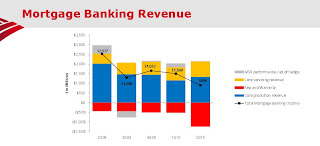 Click on graph for larger image in new window.
This graph shows the components of BofA mortgage banking revenue. The increasing red contribution is from "Rep and warranty" - these are the loans being pushed back on BofA. The second graph/chart is from First Horizon National's second quarter presentation (page 8).
Notice the pipeline of repurchase requests continues to grow, the high rescission rate of 40-50%, and the loss severity of 50-55% (the loss to First Horizon on mortgages they have to repurchase).
Note: the FHFA issued subpoenas last week "seeking documents related to private-label mortgage-backed securities" in which Fannie Mae and Freddie Mac invested. That could lead to more repurchase requests for the Wall Street banks.
BofA 30+ Day Delinquency and FHA
by Calculated Risk on 7/16/2010 11:32:00 AM
The following graph from the BofA Second Quarter 2010 Earnings Presentation says more about the FHA than BofA (ht Brian): Click on graph for larger image in new window.
For BofA, the 30+ day deliquency trends continue to improve.
That red line at the top that is still increasing? That includes FHA insured residential mortgages ...
Notice how the risk has been shifted to the FHA.
Reuters University of Michigan's Consumer Sentiment drops sharply in July
by Calculated Risk on 7/16/2010 10:01:00 AM
From Reuters: Consumer Sentiment Sinks To Lowest in 11 Months
The survey's preliminary July reading on the overall index on consumer sentiment plummeted to 66.5 from 76.0 in June.
The figure was below the median forecast of 74.5 among economists polled by Reuters.
 Click on graph for larger image in new window.
Consumer sentiment is a coincident indicator - and this is further evidence of an economic slowdown.
Interesting - the survey's one-year inflation expectations increased to 2.9% even as measured inflation has been falling.
Consumer Price Index declines 0.1% in June
by Calculated Risk on 7/16/2010 08:30:00 AM
From the BLS report on the Consumer Price Index this morning:
The Consumer Price Index for All Urban Consumers (CPI-U) declined 0.1 percent in June on a seasonally adjusted basis, the U.S. Bureau of Labor Statistics reported today. Over the last 12 months, the index increased 1.1 percent before seasonal adjustment.Even with the slight monthly increase, Owners' equivalent rent (OER) is down year-over-year.
...
The index for all items less food and energy rose 0.2 percent in June after increasing 0.1 percent in May. ... The 12-month change in the index for all items less food and energy remained at 0.9 percent for the third month in a row.
...
The index for owners' equivalent rent also rose 0.1 percent, its first increase since August 2009 ...
The general disinflationary trend continues - CPI is unchanged over the last 8 months - and with all the slack in the system (especially the 9.5% unemployment rate), CPI will probably stay low or even fall further.
Thursday, July 15, 2010
HUD announcement: FHA Seller concession to be cut in half
by Calculated Risk on 7/15/2010 07:45:00 PM
From HUD: HUD seeks Public Comment on Three Initiatives to Boost FHA Capital Reserves
For the next 30 days, HUD is seeking public comment on the following policy changes, each of which are designed to mitigate risk to the Mutual Mortgage Insurance Fund while promoting sustainable homeownership for FHA borrowers:This will become effective after the 30 day comment period - so around August 15th.1. Update the combination of credit and down payment requirements for new borrowers. New borrowers seeking FHA-insured financing will be required to have a minimum FICO score of 580 to qualify for FHA’s flagship 3.5 percent down payment program. New borrowers with credit scores of less than a 580 will be required to make a cash investment of at least 10 percent. Borrowers with credit scores of less than 500 will no longer qualify for an FHA-insured mortgage.
2. Reduce allowable seller concessions from six to three percent. Allowing sellers to contribute up to six percent of the home’s sales price to offset a buyer’s costs exposes the FHA to excess risk by potentially driving up the cost of the home beyond its appraised value. Reducing seller concessions to three percent will bring FHA into conformity with industry standards.
3. Tighten underwriting standards for manually underwritten loans. When using compensating factors in the underwriting process, lenders will be required to consider those factors which are the best predictive indicators of loan performance, such as the borrower’s credit history, loan-to-value (LTV) percentage, debt-to income ratio, and cash reserves.
Update: For more details, here is the public notice.
Reports: BP makes progress on Oil Gusher, SEC to make "significant announcement"
by Calculated Risk on 7/15/2010 03:58:00 PM
From the WSJ: Oil Stops Flowing as BP Tests Cap
From the SEC:
The SEC Enforcement Division is holding a news conference at 4:45 p.m. ET to make a significant announcement.There will be a webcast here. Rumors are about Goldman Sachs - but we will know in 45 minutes.
UPDATE: Goldman Sachs settles with SEC, agrees to pay $550 million.
News release
The Securities and Exchange Commission today announced that Goldman, Sachs & Co. will pay $550 million and reform its business practices to settle SEC charges that Goldman misled investors in a subprime mortgage product just as the U.S. housing market was starting to collapse.Goldman Consent
In agreeing to the SEC's largest-ever penalty paid by a Wall Street firm, Goldman also acknowledged that its marketing materials for the subprime product contained incomplete information.
Proposed judgment
Hotel Occupancy Rate increases compared to same week in 2009
by Calculated Risk on 7/15/2010 12:36:00 PM
Hotel occupancy is one of several industry specific indicators I follow ...
First, some comments from the Marriott conference call today:
After dropping for eight straight quarters occupancy rates bottomed in the Fourth Quarter of 2009. .. [W]e said we hope to increase room rates year-over-year, some time in 2010. As it turned out we were able to increase room rates much faster than we anticipated. In period five roughly equivalent to May, domestic Company operated room rates rose 1%. The first increase in nearly two years. In period six, roughly equivalent to June, domestic Company operated room rates rose 3%.And from HotelNewsNow.com: STR: US results for week ending 3 July 2010
...
Leisure demand in the Second Quarter ... was solid. On weekdays Marriott brand REVPAR rose an impressive 9% in the quarter but weekends held their own with REVPAR up 5%.
...
Business in Europe and the UK remains strong despite rumbling of economic concern. Our European hotels are benefiting from strong American tourism, attracted to fabulous destinations that are on sale due to the weaker currencies. In Asia, occupancy rates at Company operated hotels rose over 16 points as newer hotels continued to mature and the Shanghai world expo attracted strong demand.
Overall, in year-over-year measurements, the industry’s occupancy increased 3.9 percent to 62.5 percent, ADR rose 0.4 percent to US$94.69, and RevPAR was up 4.3 percent to US$59.17.The following graph shows the four week moving average for the occupancy rate by week for 2008, 2009 and 2010 (and a median for 2000 through 2007).
 Click on graph for larger image in new window.
Notes: the scale doesn't start at zero to better show the change.
On a 4-week basis, occupancy is up 6.5% compared to last year (the worst year since the Great Depression) and 5.3% below the median for 2000 through 2007.
A little more than half way back ...
Data Source: Smith Travel Research, Courtesy of HotelNewsNow.com



