
 RSS Feed
 by Calculated Risk on 6/07/2010 03:00:00 PM
Monday, June 07, 2010
Consumer Credit increases slightly in April
The Federal Reserve reports:
Consumer credit increased at an annual rate of 1/2 percent in April 2010. Revolving credit decreased at an annual rate of 12 percent, and nonrevolving credit increased at an annual rate of 7 percent.
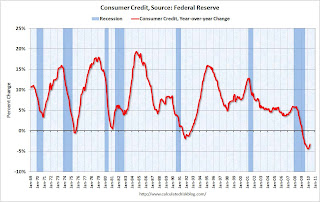 Click on graph for larger image in new window.
This graph shows the year-over-year (YoY) change in consumer credit. Consumer credit is off 3.2% over the last 12 months.
Note: The Fed reports a simple annual rate (multiplies change in month by 12) as opposed to a compounded annual rate. Consumer credit does not include real estate debt.
Usually there is a fairly sharp increase in consumer credit during a robust recovery - but that isn't happening this time because household balance sheets are still a mess. Just another reminder that the recovery will be sluggish and choppy ...
Impact of Decennial Census on Unemployment Rate
by Calculated Risk on 6/07/2010 12:00:00 PM
Last week I posted the Impact of Census 2010 on Payroll Report
My estimate was that the 2010 Census would add 417,000 payroll jobs in May; the actual was 411,000 payroll jobs.
My preliminary estimate is the Census will subtract 200,000 payroll jobs in June - and most of the remaining temporary Census jobs (564,000 total in May) will be unwound by September.
I've been puzzling over how much (if any) these temporary jobs lowered the unemployment rate in May. I think these workers come from three groups:
1) already employed workers taking a part time job,
2) people not in the workforce picking up a little temporary income (like retirees or students who would otherwise not be in the workforce), and
3) the unemployed taking a part time job.
Sure enough there was an increase in people working multiple jobs in May. The number of multiple jobholders jumped by 210,000 in May (seasonally adjusted). There can be other reasons for this increase, but if we assume these are mostly Census workers, then about half the 411,000 additional Census workers already have other jobs - so for these workers, the temporary Census jobs has no impact on the unemployment rate.
The other half are probably otherwise unemployed workers, or people not in the workforce (although the participation rate declined in May). If we assume that this is mostly unemployed workers, these temporary hires lowered the unemployment rate by around 0.1% (from 9.8% to 9.7%).
Tim Duy: Lost Chance for Global Rebalancing
by Calculated Risk on 6/07/2010 08:35:00 AM
Professor Duy is not happy: A Good Crisis, Wasted
It is official. The rest of the world assumes the economy can pick up were we left off in 2006, with the US as the driver of global demand. And it is apparent there is little US policymakers can or will do to counter the trend. Once again, crisis - and along with it the opportunity to rebalance global growth - is wasted.Not only are we headed back to the pre-crisis imbalances, this suggests that unemployment in the U.S. will stay elevated for some time.
...
Don Geithner [is] tilting at windmills. His battles are futile. Financial markets know it, sensing that the global growth cannot be sustained on the back of the US alone. Of course, this was always the case; demand in the US alone was never sufficient to recreate the fabled "V" recovery of the 1980s. Market participants also know that US policymakers have their finger in the dam of a tidal wave of competitive devaluations. The Dollar, for all its warts, remains the big dog of reserve currencies, and Geithner fears the global pandemonium that would result from an actual US response to the currency manipulation of others. Thus the postponed report on currency manipulators becomes another case of "extend and pretend."
In the end, why continue to hold the Euro on what is increasingly the myth of global rebalancing? It is clear European policymakers want a weaker Euro, and US policymakers are powerless to prevent a stronger dollar. At least we are getting cheaper oil as a result.
When it all shakes out, the US will actually be asked to do more, not less.
...
Where does this all leave us? The rest of the world is intent on pursuing a begger thy neighbor strategy, with the US being the neighbor. I suspect US policymakers will eventually relent; it will be the only choice left. All we can do now is sit back and wait for the inevitable explosion in the US trade deficit, waiting idly by for the next crisis and the "chance" to bring some sanity to the global financial architecture.
Sunday, June 06, 2010
Sunday Night Futures
by Calculated Risk on 6/06/2010 10:55:00 PM
Note: Here is the weekly summary and a look ahead (with plenty of interesting graphs).
The Asian markets are red tonight with the Nikkei off 4%.
From CNBC: Pre-Market Data shows the S&P 500 off about 8 or less than 1%. Dow futures are off about 70 points.
The Euro is down against at 1.19 dollars
Best to all.
Hungary: Never mind
by Calculated Risk on 6/06/2010 06:20:00 PM
Here is the weekly summary and look ahead.
The furious backpedaling continues ...
From the WSJ: Hungary Seeks to Reassure Lenders and Investors
Hungary's new cabinet huddled in an emergency session over the weekend to devise an economic plan aimed at restoring confidence in the nation's creditworthiness, as the government backtracked on officials' earlier comments that the country could default on its debts.
From Reuters: Analysis: Hungary faces struggle to regain trust of markets
Hungary is likely to take months to regain the trust of financial markets after politicians in its new government made controversial comments ...The euro is down to 1.1956 dollars.
This makes me think of Gilda Radner: "Never mind".
Weekly Summary and a Look Ahead
by Calculated Risk on 6/06/2010 11:59:00 AM
The key economic report this week will be April retail sales to be released on Friday.
On Monday, the Fed will release Consumer Credit for April at 3 PM ET. Consumer credit has declined sharply since mid-2008, especially revolving debt (credit cards). Also this week, the May rail traffic report from the Association of American Railroads (AAR) and May LA port traffic will probably be released.
On Tuesday, the National Association of Independent Business (NFIB) will release the small business optimism survey for May. The NFIB pre-released the employment survey on Friday and the employment outlook was described as “bleak”. Also on Tuesday the Job Openings and Labor Turnover Survey (JOLTS) for April will be released at 10 AM by the BLS. This report has been showing very little turnover in the labor market and few job openings.
On Wednesday, the MBA will release the mortgage purchase applications index. This has been falling sharply suggesting a sharp decline in home sales after the expiration of the tax credit. Also on Wednesday, Wholesale Inventories and the Fed’s Beige Book will be released. Fed Chairman Ben Bernanke will testify at 10 AM before the house budget committee (the hearing is about the State of the Economy: View from the Federal Reserve), and the NY Fed’s Brian Sack will speak at noon at the New York Association of Business Economics.
On Thursday the April Trade Balance report will be released at 8:30 AM by the Census Bureau. The consensus is for a further increase in the U.S. trade deficit to around $41 billion (from $40.4 billion). Also on Thursday, the closely watched initial weekly unemployment claims will be released. Consensus is for a decline to 448K from 453K last week.
Also on Thursday, the Fed will release the Q1 Flow of Funds report, and the May Ceridian-UCLA Pulse of Commerce Index (based on diesel fuel consumption) will be released. Last month this was the one of the first indicators that showed the economy slowed in April.
On Friday May retail sales will be released at 8:30 AM. The consensus is for an increase of 0.3% from the April rate, and 0.1% increase ex-autos. Also the May Reuter's/University of Michigan's Consumer sentiment index will be released at 9:55 AM, and April Business inventories will be released at 10 AM.
And of course the FDIC will probably have another busy Friday afternoon ...
And a summary of last week:
From the BLS:
Total nonfarm payroll employment grew by 431,000 in May, reflecting the hiring of 411,000 temporary employees to work on Census 2010, the U.S. Bureau of Labor Statistics reported today. ... The unemployment rate edged down to 9.7 percent.
 Click on graphs for a larger image.
This graph shows the job losses from the start of the employment recession, in percentage terms. This really shows how stunning the job losses were during the great recession.
The dotted line is the job losses ex-Census. Census 2010 hiring was 411,000 in May.
The recession that started in 2007 was by far the worst recession since WWII in percentage terms, and 2nd worst in terms of the unemployment rate (only early '80s recession with a peak of 10.8 percent was worse).
 This graph shows the same data, but this time aligned at the bottom of the recession.
Notice that the 1990 and 2001 recessions were followed by jobless recoveries - and the eventual job recovery was gradual. In earlier recessions the recovery was somewhat similar and a little faster than the decline (somewhat symmetrical).
 This graph shows the Employment-Population ratio. The ratio decreased to 58.7% in May (from 58.8% in April). This had been increasing after plunging since the start of the recession.
Note: the graph doesn't start at zero to better show the change.
The Labor Force Participation Rate decreased to 65.0% from 65.2% in April. This is the percentage of the working age population in the labor force. This decline is disappointing. The decline in participation was a key reason the unemployment rate declined.
 This graph shows the long term unemployed. The blue line is the number of workers unemployed for 27 weeks or more. The red line is the same data as a percent of the civilian workforce.
According to the BLS, there were a record 6.72 million workers who had been unemployed for more than 26 weeks (and still want a job). This was a record 4.34% of the civilian workforce. (note: records started in 1948)
 Based on an estimate from Autodata Corp, light vehicle sales were at a 11.63 million SAAR in May. This is up 18.1% from May 2009 (when sales were very low), and up 3.9% from the April sales rate.
This graph shows the historical light vehicle sales (seasonally adjusted annual rate) from the BEA (blue) and an estimate for May (red, light vehicle sales of 11.63 million SAAR from Autodata Corp).
 The 136,142 consumer bankruptcies filed in May represented a 9 percent increase from May 2009 total.
 This graph shows the non-business bankruptcy filings by quarter using monthly data from the ABI and previous quarterly data from USCourts.gov.
The American Bankruptcy Institute (ABI) has increased their forecast to over 1.6 million filings this year .
 This graph shows private residential and nonresidential construction spending since 1993. Note: nominal dollars, not inflation adjusted.
Private residential construction spending appears to have bottomed in early 2009, but has been mostly moving sideways since then. Residential spending is now 61% below the peak of early 2006.
Private non-residential construction spending is now 29% below the peak of late 2008.
Best wishes to all.
Krugman: "Lost Decade, Here We Come"
by Calculated Risk on 6/06/2010 08:49:00 AM
First, from the Financial Times: G20 drops support for fiscal stimulus
Finance ministers from the world’s leading economies ripped up their support for fiscal stimulus on Saturday ...And from the G20 communiqué:
The communiqué of the meeting made it clear that the G20 no longer thought that expansionary fiscal policy was sustainable or effective in fostering an economic recovery because investors were no longer confident about some countries’ public finances.
Excerpts with permission
The recent events highlight the importance of sustainable public finances and the need for our countries to put in place credible, growth-friendly measures, to deliver fiscal sustainability, differentiated for and tailored to national circumstances. Those countries with serious fiscal challenges need to accelerate the pace of consolidation.And from Paul Krugman: Lost Decade, Here We Come
It’s basically incredible that this is happening with unemployment in the euro area still rising, and only slight labor market progress in the US.
...
The right thing, overwhelmingly, is to do things that will reduce spending and/or raise revenue after the economy has recovered — specifically, wait until after the economy is strong enough that monetary policy can offset the contractionary effects of fiscal austerity. But no: the deficit hawks want their cuts while unemployment rates are still at near-record highs and monetary policy is still hard up against the zero bound.
...
Utter folly posing as wisdom. Incredible.
Saturday, June 05, 2010
Daily Show: The Spilling Fields
by Calculated Risk on 6/05/2010 10:28:00 PM
Since we all need a laugh - Jon Stewart has a suggestion for how to use a vacant McMansion ... Here is the link at the Daily Show
| The Daily Show With Jon Stewart | Mon - Thurs 11p / 10c |
| The Spilling Fields - To Shell and Back | |
Fannie Mae's Duncan: Home-building industry to be tested until early 2013
by Calculated Risk on 6/05/2010 05:46:00 PM
Some comments from Fannie Mae chief economist Douglas Duncan ...
From Greta Guest at Freep.com:
Douglas Duncan, chief economist for Fannie Mae, said he expects the home-building industry to be tested until early 2013 before demand will catch up with the large supply of houses on the market.And from Elizabeth Razzi at the WaPo: Is bulldozer the best option for some boom-time housing?
He said the combination of current inventory of unsold homes plus the foreclosures not yet for sale has elevated supply by roughly 2 million houses over normal levels.
He said that housing starts would be below normal levels until that inventory is absorbed.
Said Duncan: "Some of that shadow investment could have to be torn down. It was not economically viable when it was put in place." ... Duncan said people could find that the cost of sustaining their lifestyle in some developments--including high transportation costs to far-away jobs--is greater than the cost of the home. That would wipe out demand.And I posted this comment yesterday via Kathleen Howley and Daniel Taub at Bloomberg: Fannie Mae’s Duncan Says Homebuyer Tax Credit Shifted Demand
...
The idea is being discussed by economists, but Duncan said he doesn't know of any policymakers who are considering it. "It's un-American to think about tearing down housing," he said. "But we have a long history of ghost towns."
“Temporary tax credits change behavior temporarily. It’s simply shifted demand forward. ... It actually created some price appreciation that’s not supportable long term.” [said Douglas Duncan, Fannie Mae chief economist]
Duration of Unemployment
by Calculated Risk on 6/05/2010 01:16:00 PM
 This graph shows the duration of unemployment as a percent of the civilian labor force. The graph shows the number of unemployed in four categories as provided by the BLS: less than 5 week, 6 to 14 weeks, 15 to 26 weeks, and 27 weeks or more.
Note: The BLS reports 15+ weeks, so the 15 to 26 weeks number was calculated.
As we've discussed before there was more turnover in the '70s and '80s - back then the 'less than 5 weeks' category was much higher as a percent of the civilian labor force than in recent years.
What really makes the current period stand out is the number of people (and percent) that have been unemployed for 27 weeks or more (red line). In the early '80s, the 27 weeks or more unemployed peaked at 2.9 million or 2.6% of the civilian labor force.
In May 2010, there were a record 6.763 million people unemployed for 27 weeks or more, or a record 4.38% of the labor force. This is significantly higher than during earlier periods.
It does appear the number of long term unemployed is near a peak (the increases have slowed). But it is still very difficult for these people to find a job - and this is a very serious employment issue.



