
 RSS Feed
 by Calculated Risk on 5/02/2010 12:35:00 PM
Sunday, May 02, 2010
Weekly Summary and a Look Ahead
The key economic report for the week will be the April Employment Report to be released on Friday.
On Monday the Personal Income and Outlays report for March will be released at 8:30 AM ET. This will also include the underlying details for the Q1 GDP report. At 10 AM ET, the ISM Manufacturing index for April will be released (expectations are for an increase to 61 from 59.6 in March) and Construction Spending for March (consensus is for another decline in spending).
Also on Monday, the automakers will report vehicle sales for April. Expectations are for a slight increase from the 11.75 million SAAR for light vehicles in March. The American Bankruptcy Institute will probably report personal bankruptcy filings for April too. This will probably show another "surge" in filings.
On Tuesday, the Census Bureau will release factory orders for March, and the NAR will release March Pending Home Sales at 10 AM (expect a tax credit related increase).
On Wednesday, the ADP employment report will be released (consensus is for an increase of 28K private sector jobs). This will probably be the first increase in the ADP employment report since the recession started. Also on Wednesday, the ISM non-manufacturing report for April will be released. Consensus is for an increase in the service sector.
On Thursday, the closely watched initial weekly unemployment claims will be released. Consensus is for a decline to 440K from 448K last week. Also the Q1 Productivity and Costs report will be released at 8:30 AM.
Also on Thursday, Fed Chairman Ben Bernanke will speak at 9:30 AM at the Chicago Federal Reserve Bank 46th Annual Conference on Bank Structure. There are some interesting topics being covered at the conference, including a discussion of The Future of the Housing GSEs.
And on Friday, the BLS will release the April Employment report at 8:30 AM. The consensus is for a gain of 200K in payroll jobs in April (about 100K from temporary census hiring), and for the unemployment rate to decline slightly to 9.6%. It will be important to remove the Census hiring to try to determine the underlying trend.
Also on Friday the Federal Reserve will release consumer credit for March (expectations are for another decline in credit), and of course the FDIC will probably have another busy Friday afternoon ...
The NMHC Apartment Tightness index for Q1 might be released with week. This is a leading indicator for apartment rents.
And a summary of last week:
From the BEA: Gross Domestic Product: First Quarter 2010. A couple of graphs ...
The first graph shows the rolling 4 quarter contribution to GDP from residential investment, equipment and software, and nonresidential structures. Red is residential, green is equipment and software, and blue is investment in non-residential structures. The usual pattern - both into and out of recessions is - red, green, blue.
 Click on graph for larger image in new window.
The key leading sector - residential investment - is lagging the recovery because of the huge overhang of existing inventory. Usually RI is a strong contributor to GDP growth and employment in the early stages of a recovery, but not this time - and this is a key reason why the recovery has been sluggish so far.
 The second graph shows real personal income less transfer payments as a percent of the previous peak.
Unlike the recovery in GDP, real personal income less transfer payments has barely increased and is still 6.6% below the pre-recession level.
The peak of the stimulus spending is in Q2 2010 (right now), and then the stimulus spending starts to taper off in the 2nd half of 2010. So underlying demand better increase soon - and that means jobs and incomes going forward.
The Fed's favorite house price indicator from First American CoreLogic’s LoanPerformance ...
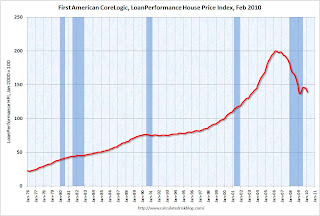 This graph shows the national LoanPerformance data since 1976. January 2000 = 100.
The index is up 0.3% over the last year and off 30.6% from the peak.
House prices are off 4.9% from the recent peak in August 2009 (although some of the decline is seasonal).
 This graph shows the nominal not seasonally adjusted Composite 10 and Composite 20 indices (the Composite 20 was started in January 2000).
The Composite 10 index is off 30.0% from the peak, and up slightly in February (SA).
The Composite 20 index is off 29.3% from the peak, and down slightly in February (SA).
 The next graph shows the price declines from the peak for each city included in S&P/Case-Shiller indices.
Prices decreased (SA) in 15 of the 20 Case-Shiller cities in February.
Prices in Las Vegas are off 55.7% from the peak, and prices in Dallas only off 6.0% from the peak.
The Census Bureau reported the homeownership and vacancy rates for Q1 2010 this morning.
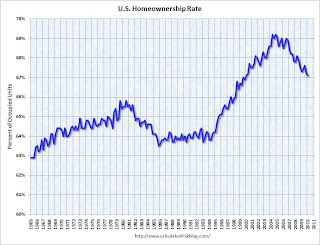 The homeownership rate declined to 67.1%. This is the lowest level since Q1 2000.
 Note: graph starts at 60% to better show the change.
The homeownership rate increased in the '90s and early '00s because of changes in demographics and "innovations" in mortgage lending. The increase due to demographics (older population) will probably stick, so I've been expecting the rate to decline to the 66% to 67% range - and not all the way back to 64% to 65%.
Best wishes to all.
Greece Reaches Bailout Deal
by Calculated Risk on 5/02/2010 09:01:00 AM
From the NY Times: Greece Reaches Agreement on Bailout
Prime Minister George Papandreou said Sunday that Greece had reached an agreement with the International Monetary Fund and European Union on a long-delayed rescue package that is expected to be as much as €120 billion.More details will be available later today. Greece might be in recession for several years ...
...
Finance Minister George Papaconstantinou set out some of the details of the austerity measures that are required for the bailout package, which were expected to be revealed in Brussels later Sunday. He said that Greece would make budget cuts of €30 billion, or $40 billion, to reduce the budget deficit to below 3 per cent by 2014.
...
Indicating that the steps would undermine economic growth, Mr. Papaconstantinou forecast a deeper than expected recession of 4 per cent for 2010, and 2.6 percent in 2011, before the economy returned to growth of 1.1 percent in 2012.
“We will be in recession for the next few years which means that we have to run faster to reduce the deficit,” he said.
More details from Bloomberg: Greece Accepts Terms of EU-Led Bailout, ‘Savage’ Cuts
Saturday, May 01, 2010
Fed Discussed Possible Housing Bubble in 2004
by Calculated Risk on 5/01/2010 08:53:00 PM
The Fed released the transcripts for the 2004 FOMC meeting this week. There definitely was some mention of a possible housing bubble, but little discussion.
From June 30, 2004: 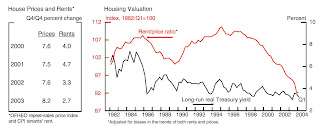 Click on graph for larger image in new window.
This graph shows the Fed estimate of the rent-to-price ratio in June 2004. Usually this is drawn inverted (Price-to-rent). And this was after the Fed made some technical adjustments - otherwise, in the words of a Fed researcher, the graph would "have looked more alarming".
MR. FERGUSON [Roger Ferguson, Fed Vice Chairman in 2004]: The other question I have deals with chart 3, on housing prices. My question is about the footnote, which says that the rent–price ratio is adjusted for biases in the trends of both rents and prices. Is that where you pick up demographics and lifecycle factors? What are these biases in the trends, and how does one think about changing demographics and the relative attractiveness of owning a home versus renting? Give me some sense of whether or not the shape of the curve that you show here is likely to reverse, as you imply, or likely to stay relatively low.
MR. OLINER [Stephen Oliner, Fed associate research director]: The biases referred to in that footnote were really technical biases in the construction of the two measures shown here, the rent measure and the price measure. Had we not adjusted for them, the rent-to-price ratio would have been much lower at the end point. So it would have looked more alarming. In part we think the published data have some technical problems that need to be taken care of before this analysis can be done in a way that is meaningful. With regard to the question of owning versus renting, it depends to some extent on what is happening to interest rates because that changes that calculation at the margin. So it’s really important to plot any kind of valuation measure relative to an opportunity cost. Just showing the rent-to-price ratio I think would have been somewhat misleading; it’s really that gap that we think is the meaningful measure of valuation. And it looks somewhat rich, taking account of the fact that interest rates are relatively low and income growth has been relatively strong. I don’t want to leave the impression that we think there’s a huge housing bubble. We believe a lot of the rise in house prices is rooted in fundamentals. But even after you account for the fundamentals, there’s a part of the increase that is hard to explain.
And a couple of comments from the March 2004 meeting:
MR. GUYNN [Atlanta Fed President]: We keep looking to our directors and other contacts for indications of imbalances and pricing pressures that they might see developing, and we’ve begun to get hints of both. A number of folks are expressing growing concern about potential overbuilding and worrisome speculation in the real estate markets, especially in Florida. Entire condo projects and upscale residential lots are being pre-sold before any construction, with buyers freely admitting that they have no intention of occupying the units or building on the land but rather are counting on “flipping” the properties—selling them quickly at higher prices.
...
MR. KOHN [Fed Governor]: House prices are elevated relative to rents—and will look even more so when rates begin to rise—but are more likely to correct by rising less rapidly than by crashing. Eggs will get broken when rates begin to rise, but the capital in most intermediaries is high, and the system is resilient.
CR: Rampant speculation, an "alarming" price-to-rent chart, prices rising faster than explained by fundamentals, "eggs will be broken" - and this was in 2004. And Kohn was wrong - the system wasn't "resilient".
Investment Contributions to GDP: Leading and Lagging Sectors
by Calculated Risk on 5/01/2010 03:57:00 PM
By request, the following graph is an update to: The Investment Slump in Q2 2009
The following graph shows the rolling 4 quarter contribution to GDP from residential investment, equipment and software, and nonresidential structures. This is important to follow because residential investment tends to lead the economy, equipment and software is generally coincident, and nonresidential structure investment trails the economy.
For the following graph, red is residential, green is equipment and software, and blue is investment in non-residential structures. The usual pattern - both into and out of recessions is - red, green, blue. Click on graph for larger image in new window.
Residential Investment (RI) made a small positive contribution to GDP in the second half of 2009, but was a drag in Q1 2010. The rolling four quarter change is moving up, but as expected there has been no strong boost to GDP from RI.
Equipment and software investment has made a positive contribution to GDP for three straight quarters (it is coincident).
Nonresidential investment in structures continues to be a drag on the economy, and as usual the economy is recovering long before nonresidential investment in structures recovers.
The key leading sector - residential investment - is lagging the recovery because of the huge overhang of existing inventory. Usually RI is a strong contributor to GDP growth and employment in the early stages of a recovery, but not this time - and this is a key reason why the recovery has been sluggish so far.
Freddie Mac: 90+ Day Delinquency Rate at 4.13% in March
by Calculated Risk on 5/01/2010 11:57:00 AM
Note: Freddie Mac reported the serious delinquency rate decreased in March from February, but that is only after the previous months were revised higher. Also there might be some distortion from the modification program - loans in trial mods were considered delinquent until the modifications were made permanent.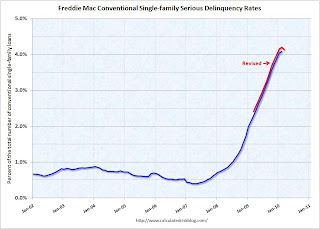 Click on graph for larger image in new window.
Freddie Mac reported that the rate of serious delinquencies - at least 90 days behind - for conventional loans in its single-family guarantee business decreased to 4.13% in March 2010, down from 4.20% in February - and up from 2.41% in March 2009.
"Single-family delinquencies are based on the number of mortgages 90 days or more delinquent or in foreclosure as of period end ..."
The data from Fannie Mae will be released next week ...
96.5% of Mortgages Backed by Government entities in Q1
by Calculated Risk on 5/01/2010 08:42:00 AM
From Nick Timiraos at the WSJ: U.S. Role in Mortgage Market Grows Even Larger
Government-related entities backed 96.5% of all home loans during the first quarter, up from 90% in 2009, according to Inside Mortgage Finance.The following graph from San Francisco Fed Senior Economist John Krainer puts this in perspective (from Oct 2009): Recent Developments in Mortgage Finance
As the U.S. housing market has moved from boom in the middle of the decade to bust over the past two years, the sources of mortgage funding have changed dramatically. The government-sponsored enterprises—Fannie Mae, Freddie Mac, and Ginnie Mae—now own or guarantee an overwhelming share of originations. At the same time, non-agency mortgage securitization and loans retained in lender portfolios have largely dried up.
 Click on graph for slightly larger in new window.
This is figure 3 from the Economic Letter.
[T]he sources of mortgage finance have shifted as the housing market has gone from boom to bust. Figure 3 plots the evolution of these funding sources over the past decade. Fannie Mae and Freddie Mac combined have consistently been the largest players in the market, owning or guaranteeing about half or more of the mortgages in the sample at any given time. Non-agency securitization peaked in the first quarter of 2006, when it accounted for nearly 40% of new originations. Finally, the share of mortgages retained in the originating institution's portfolio averaged about 15% throughout the boom, but has fallen considerably since.Without the government backed entities there would be almost no mortgage market. We are a long way from normal ...
...
With the vast majority of current mortgage lending now intermediated in some form by the GSEs, it will be difficult for the housing market to return to normal.
Friday, April 30, 2010
Unofficial Problem Bank List hits 722
by Calculated Risk on 4/30/2010 11:46:00 PM
This is an unofficial list of Problem Banks compiled only from public sources.
Here is the unofficial problem bank list for April 30, 2010.
Changes and comments from surferdude808:
Failure Friday and the FDIC issuing its enforcement actions for March contributed to many changes in the Unofficial Problem Bank List.The list keeps growing ...
Of the seven failures this week, six were on the list including Westernbank Puerto Rico ($11.9 billion), R-G Premier Bank of Puerto Rico ($6.1 billion), Frontier Bank ($3.6 billion), Eurobank ($2.6 billion), CF Bancorp ($1.7 billion), and BC National Banks ($67 million). There was one other removal as the action against University Bank ($134 million) was terminated.
Thirty-five institutions with aggregate assets of $9.8 billion made their first appearance on the list this week. Among the additions are FSGBank, National Association, Chattanooga, TN ($1.4 billion Ticker: FSGI); Centennial Bank, Fountain Valley, CA ($848 million); Beach Community Bank, Fort Walton Beach, FL ($706 million Ticker: BCBF); and CIBM Bank, Champaign, IL ($698 million Ticker: CIBH). The additions include four institutions based in Illinois, Minnesota, and Nevada, and three in Florida, Georgia, Texas, and Washington.
The FDIC also issued Prompt Corrective Action orders against a few banks already on the Unofficial Problem Bank List including Nevada Security Bank, Reno, NV ($502 million) and Sun West Bank, Las Vegas, NV ($381 million). After the failures and additions, the Unofficial Problem Bank List stands at 722 institutions with aggregate assets of $349.8 billion.
This week, Cascade Bank, Everett, WA ($1.7 billion Ticker: CASB) disclosed that it now expects to sign a Consent Order in Q2."[I]n light of the current challenging operating environment, along with our elevated level of nonperforming assets and adversely classified assets and our recent operating results, we expect Cascade Bank to enter into a Consent Order with the FDIC and Washington State DFI during the second quarter. We expect that under the Order, Cascade Bank will be required, among other things, to improve asset quality and reduce classified assets; to improve profitability; and to increase Tier 1 capital.
We also expect the Company will enter into a similar Order with the Federal Reserve Bank of San Francisco."
Bank Failure #64: Frontier Bank, Everett, Washington
by Calculated Risk on 4/30/2010 09:14:00 PM
A limitless horizon
Much like our debt load.
by Soylent Green is People
From the FDIC: Union Bank, National Association, San Francisco, California, Assumes All of the Deposits of Frontier Bank, Everett, Washington
Frontier Bank, Everett, Washington, was closed today by the Washington Department of Financial Institutions, which appointed the Federal Deposit Insurance Corporation (FDIC) as receiver. ...Is that about $7 billion today?
As of December 31, 2009, Frontier Bank had approximately $3.50 billion in total assets and $3.13 billion in total deposits. ...
The FDIC estimates that the cost to the Deposit Insurance Fund (DIF) will be $1.37 billion. ... Frontier Bank is the 64th FDIC-insured institution to fail in the nation this year, and the sixth in Washington. The last FDIC-insured institution closed in the state was City Bank, Lynnwood, on April 16, 2010.
Bank Failure #63: BC National Banks, Butler, Missouri
by Calculated Risk on 4/30/2010 07:33:00 PM
Deposits gone with the wind
I don't give a damn
by Soylent Green is People
From the FDIC:Community First Bank, Butler, Missouri, Assumes All of the Deposits of BC National Banks, Butler, Missouri
BC National Banks, Butler, Missouri, was closed today by the Office of the Comptroller of the Currency, which appointed the Federal Deposit Insurance Corporation (FDIC) as receiver. ..
As of December 31, 2009, BC National Banks had approximately $67.2 million in total assets and $54.9 million in total deposits. ...
The FDIC estimates that the cost to the Deposit Insurance Fund (DIF) will be $11.4 million. ... BC National Banks is the 63rd FDIC-insured institution to fail in the nation this year, and the third in Missouri. The last FDIC-insured institution closed in the state was Champion Bank, Creve Coeur, earlier today.
Bank Failure #62: Champion Bank, Creve Coeur, Missouri
by Calculated Risk on 4/30/2010 06:34:00 PM
The breakfast of Champion
They drank our milk shake
by Soylent Green is People
From the FDIC: Bankliberty, Liberty, Missouri, Assumes All of the Deposits of Champion Bank, Creve Coeur, Missouri
Champion Bank, Creve Coeur, Missouri, was closed today by the Missouri Division of Finance, which appointed the Federal Deposit Insurance Corporation (FDIC) as receiver. ...Busy day ...
As of December 31, 2009, Champion Bank had approximately $187.3 million in total assets and $153.8 million in total deposits....
The FDIC estimates that the cost to the Deposit Insurance Fund (DIF) will be $52.7 million. ... Champion Bank is the 62nd FDIC-insured institution to fail in the nation this year, and the second in Missouri. The last FDIC-insured institution closed in the state was Bank of Leeton, Leeton, on January 22, 2010.



