
 RSS Feed
 by Calculated Risk on 1/13/2009 03:26:00 PM
Tuesday, January 13, 2009
WSJ: Citi to Announce Major Reorganization
From the WSJ: Citi Preparing Major Overhaul
Citigroup ... is preparing to unveil a major reorganization ... In addition to spinning off the New York company's Smith Barney ... Citigroup is preparing to narrow its overall mission to two areas ... wholesale banking for large corporate clients and retail banking for customers in selected markets around the world.
Credit Crisis Indicators: TED Spread Below 1.0
by Calculated Risk on 1/13/2009 01:25:00 PM
Here are a few indicators of credit stress:
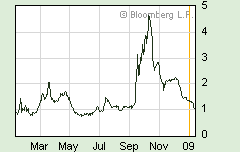 | The TED spread was stuck above 2.0 for some time. The peak was 4.63 on Oct 10th. The TED spread has finally moved below 1.0, although a normal spread is around 0.5. |

This is the spread between high and low quality 30 day nonfinancial commercial paper. Right now quality 30 day nonfinancial paper is yielding close to zero. If the credit crisis eases, I'd expect a significant further decline in this spread - although this is good progress.
 |
By these indicators, the Fed is making progress.
Federal Home Loan Bank of Seattle Suspends Dividend
by Calculated Risk on 1/13/2009 11:10:00 AM
The FHLBs are probably about to become a huge story.
From Bloomberg: Seattle FHLB Likely Short of Capital on Mortgage Debt (hat tip Brian)
The Federal Home Loan Bank of Seattle joined its San Francisco counterpart in suspending dividends and “excess” stock repurchases, after the declining value of mortgage bonds likely led to a regulatory capital shortfall.From Roubini's testimony to Congress on February 26th, 2008:
The shortfall is being caused by “unrealized market value losses” on home-loan securities without government backing, the Seattle bank cooperative said in a filing with the U.S. Securities and Exchange Commission today.
...
The FHLB system has $1.25 trillion of debt, making it the largest U.S. borrower after the federal government.
[T]he widespread use of the FHLB system to provide liquidity – but more clearly bail out insolvent mortgage lenders – has been outright reckless. ... A system that usually provides a lending stock of about $150 billion has forked out loans amounting to over $750 billion in the last year with very little oversight of such staggering lending. The risk that this stealth bailout of many insolvent mortgage lenders will end up costing massive amounts of public money is now rising.
Beazer Homes: Sales Off more than 50%
by Calculated Risk on 1/13/2009 10:27:00 AM
From Beazer Homes press release:
Home closings for the quarter ended December 31, 2008 totaled 938, a 53.2% decline from 2,006 homes closed during the same period in the prior fiscal year. Net new home orders totaled 551 for the quarter, a decrease of 56.0% from 1,252 net orders in the first quarter of the prior fiscal year. ... The cancellation rate for the first quarter was 45.6%, compared to 46.6% for the same period in the prior year.It just keeps getting worse ...
Trade Deficit Declines Sharply
by Calculated Risk on 1/13/2009 08:45:00 AM
Both exports and imports are declining, but the decline in the trade deficit was mostly about oil prices. Petroleum import prices fell from $92 per barrel in October to under $67 per barrel in November - and will fall further in December.
The Census Bureau reports:
[T]otal November exports of $142.8 billion and imports of $183.2 billion resulted in a goods and services deficit of $40.4 billion, down from $56.7 billion in October, revised. November exports were $8.7 billion less than October exports of $151.5 billion. November imports were $25.0 billion less than October imports of $208.2 billion.
 Click on table for larger image in new window.
This graph from the Census Bureau shows that both imports and exports are declining.
Although the trade deficit is declining - and will probably decline further in December because of the continued decline in oil prices - growth in export related businesses will probably no longer be a positive for the U.S. economy as the global economy slides into recession too.
 This graph shows the U.S. trade deficit through November. The blue line is the total deficit, and the black line is the petroleum deficit, and the red line is the trade deficit ex-petroleum products. The current recession is marked on the graph.
The oil deficit declined sharply in November and will decline further in December. But even ex-petroleum, the trade deficit is still declining.
Obama Drops Jobs-Credit Proposal
by Calculated Risk on 1/13/2009 12:06:00 AM
From the WaPo: Obama Shelves Jobs-Credit Proposal
Bowing to widespread Democratic skepticism, President-elect Barack Obama will drop his bid to include a business tax break he once touted in the economic stimulus bill now taking shape on Capitol Hill, aides said last night.It's hard to analyze a plan without many details, but this seems like progress. The larger deductions for tax losses can be junked too, although the capital investment tax incentive is probably worthwhile since capital investment is falling off a cliff.
Obama suggested the $3,000-per-job credit last week as one of five individual and business tax incentives aimed at winning Republican support. He proposed $300 billion in tax relief in a bill that could reach $775 billion, and he resurrected the jobs-credit proposal from the campaign trail as one of his main provisions.
...
Obama advisers said further adjustments may be made to the president-elect's tax priorities, including to a proposed $500 payroll tax credit for individuals. ...
Obama also has suggested tax incentives for businesses to make capital investments. Such benefits are popular across party lines and have been successful in recent years. But another Obama proposal, to allow companies to deduct larger portions of recent losses, has raised eyebrows on the Hill, where lawmakers see it as a costly reward for behavior that was possibly irresponsible.
Monday, January 12, 2009
Retail Bankruptcy: Shane Jewelry
by Calculated Risk on 1/12/2009 05:18:00 PM
These will become too common to list them all ... the story also notes ShopperTrak is predicting that retail sales will likely drop 4 percent in the first quarter.
From Bloomberg: Shane Co., U.S. Jewelry Retailer, Seeks Bankruptcy
Shane Co., the family-owned jewelry retailer with 23 stores in 14 states, sought bankruptcy court protection blaming “disappointing” holiday sales and a “grim” outlook on the deepening U.S. recession.Note: The Census Bureau will release Q4 retail sales on Wednesday, and those numbers are guaranteed to be UGLY.
The 38-year-old company, based in Centennial, Colorado, listed both assets and debt of $100 million to $500 million in Chapter 11 documents filed today in U.S. Bankruptcy Court in Denver.
Alcoa: $1.2 Billion Loss
by Calculated Risk on 1/12/2009 04:21:00 PM
From MarketWatch: Alcoa swings to loss as demand, sales slump
Alcoa said it lost $1.2 billion ... Sales fell to $5.7 billion from $7 billion. Alcoa is in the midst of cutting 15,000 jobs, curbing more production, and slashing its capital budget to make it through the downtrodden economy.Alcoa announced the job cuts and the 50% reduction in planned capital expenditures (a reduction of $1.8 billion) last week. Still pretty amazing numbers ...
More CRE Woes: Multifamily housing
by Calculated Risk on 1/12/2009 03:55:00 PM
From Dow Jones: Apartment-Complex Developers Falling Behind On Loan Payments (hat tip Robert)
The rapid reversal of fortunes in commercial real estate is taking down yet another sector: multifamily housing.This is a great follow up to my post last Friday: The Residential Rental Market. I noted that despite the increase in demand for rentals, rents are now falling because of the rapid increase in supply due to condo "reconversions", builders changing the intent of new construction (started as condos but became rentals), and other reasons. And falling rents means rising delinquencies for properties purchased with overly optimistic pro forma projections.
...
While sharp declines in retail and office sectors of commercial real estate have commanded attention in recent months, some analysts say deterioration in the multifamily sector is quickly catching up. ... Much of the multifamily sector's problems center around troubles in converting apartments to condominiums, as is the case in Miami, or the challenges in converting rent-controlled units to market-rate apartments, as in Manhattan.
In Florida, California, Arizona and Nevada, the flood of unsold condominiums is entering the apartment market and the excess supply is lowering rents in those areas, Barclays Capital analysts say. That's resulted in lower revenues for owners, which in some cases is making it more difficult to keep up with mortgage payments.
...
In November, the delinquency rate on securitized loans to apartment and condominium properties rose to 1.9%, a dramatic jump from the 0.9% at the start of the year, according to Realpoint LLC ...
Obama Asks Bush to Request Remaining TARP Funds
by Calculated Risk on 1/12/2009 11:26:00 AM
WSJ Headline: Obama has asked Bush to request the remaining $350 billion in TARP funds from Congress.
UPDATE: From CNBC: Bush to Seek Rest of TARP Money At Obama's Request
President-elect Barack Obama asked President Bush to request the remaining $350 billlion of the Wall Street bailout fund, and the White House said Bush would do so.
"President Bush agreed to the president-elect's request," White House spokeswoman Dana Perino said in a statement.
...
The request would permit Obama's administration to have the ability to use the money shortly after taking office.



