
 RSS Feed
 by Calculated Risk on 12/10/2008 06:49:00 PM
Wednesday, December 10, 2008
Report: GSEs May Waive Appraisals for Refis
From Bloomberg: Fannie, Freddie May Waive Appraisals for Refinancings
Fannie Mae and Freddie Mac, the mortgage-finance companies seized by the U.S. government, are considering forgoing new appraisals on refinanced loans to help struggling homeowners, their regulator said.Update: I misread this proposal. Mort_fin notes:
“If they refinance someone, rather than doing a loan mod, do they need a new appraisal if they already have the credit?” Federal Housing Finance Agency Director James Lockhart told reporters after a speech in Washington today. “That’s an issue that’s being discussed. They’re looking at it.”
I think we're only talking rate and term refi here, and only if the GSE is refi'ing a loan it already has on its books. If today I have a $100,000 loan at 6% on an $80,000 house, and tomorrow I have a $100,000 loan at 5% on the same $80,000 house, am I better off or worse off?
FHA and VA been doing this for 25 years. FHA'S streamline refinance program and VA's interest rate reduction loan program.
Woolies to Hold Closing Down Sale
by Calculated Risk on 12/10/2008 03:10:00 PM
From The Times: Woolworths to hold huge closing down sale tomorrow after search for buyer fails
Woolworths will hold a closing down sale tomorrow after administrators failed to find a buyer for the company's 813-store retail chain.Earlier reports had Woolies possibly closing down after Christmas. I'm not sure "redundancies" - the British term for layoffs - fits when the chain is closing down completely.
...
The administrator made the announcement after informing Woolworths' staff. The closure of the stores makes mass redundancies likely. The group employs 30,000 people, approximately 25,000 of whom work in the retail arm.
Credit Crisis Indicators
by Calculated Risk on 12/10/2008 02:14:00 PM
The progress has been slow, so I've stopped posting this daily. It looks like there has been some small progress over the last week ...
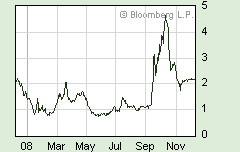 | The TED spread is stuck above 2.0, and still too high. The peak was 4.63 on Oct 10th. I'd like to see the spread move back down to 1.0 or lower. A normal spread is around 0.5. |

This is the spread between high and low quality 30 day nonfinancial commercial paper. If the credit crisis eases, I'd expect a significant decline in this spread - and the graph makes it clear this indicator is still in crisis.
Each news story of a major bankruptcy or default (like the Tribune Co.) sends this spread higher again.
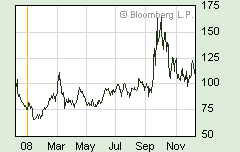 |
For the LIBOR, the TED spread, and the two-year swap, there has been some more progress. For the A2P2 spread (and all treasury yields), the markets are still in crisis.
Setser: On Global Trade and China
by Calculated Risk on 12/10/2008 11:40:00 AM
From Brad Setser: Global trade is shrinking, fast
China’s November trade data (a 2.2% year over year fall in exports; a 17.9% year over year fall in imports — see Andrew Batson of the Wall Street Journal) suggests that global trade is contracting quite rapidly. And since trade accounts for a rising share of global activity, it suggests that the global economy has stalled — and perhaps is contracting.But China may still run a strong surplus, because the decline in imports (because of falling commodity prices) will more than offset the decline in exports:
The fall in China’s exports suggests global demand is falling. And the fall in China’s imports on first blush seems larger than can be explained just by the fall in demand for imported components for China’s exports and sliding commodity prices: it suggests that Chinese domestic demand is quite weak ...
The November data from Korea and Taiwan tells a similar story. All experienced far larger falls in year over year falls in their exports than China did.
[R]ight now there isn’t any much reason to think that China’s trade surplus will shrink in 2009. Exports will fall. But so will imports. And the fall in commodity prices implies that the terms of trade have shifted in China’s favor.See Brad's post for more. The recession has gone global.
Some WaMu Office Leases might be Voided
by Calculated Risk on 12/10/2008 10:27:00 AM
Continuing a theme on commercial real estate ...
From the Obersver: It’s a WashMu! Landlords Fear Gaping Spaces as F.D.I.C. Mulls Nuclear Option (hat tip Brian)
[T]he F.D.I.C.’s October agreement with JPMorgan Chase and Washington Mutual allows Chase to pick and choose which of the city’s 148 Washington Mutual branches it will keep. Chase will then turn over the rejects to the F.D.I.C. But here’s the kicker: According to sources, the F.D.I.C. can then simply terminate the leases of those rejected branches, all contractual obligations void.
...
Francis Greenburger, chairman and CEO of Time Equities Inc. and owner of 2554 Broadway, will not be sending the F.D.I.C. a thank-you note. About five years ago, Mr. Greenburger’s firm spent more than half a million dollars wooing WaMu, which ultimately took more than 3,000 square feet at his building’s 96th Street corner. The branch has about five years left on its 10-year lease.
“We’re anticipating that Chase gives [our WaMu branch] back to the F.D.I.C., and then the F.D.I.C. gives it back to us,” Mr. Greenburger said. “Chase has a branch directly across the street.
“We’re in the middle of a recession, the worst recession since the Great Depression,” Mr. Greenburger glumly pointed out. “It’s going to be difficult to find a tenant.”
Office Depot to Close 112 Stores, Reduce New Openings
by Calculated Risk on 12/10/2008 09:16:00 AM
Press Release: Office Depot Announces Update of Strategic Review (hat tip Joshua)
The Company plans to close 112 underperforming retail stores in North America over the next three months, reducing the North American store base to 1,163. ... Additionally, 14 stores will be closed through 2009 as their leases expire or other lease arrangements are finalized.More bad news for retail space, and another company reducing capital spending plans ...
New store openings for 2009 now have been reduced to approximately 20, down from the previous estimate of 40 stores. This will facilitate a reduction in total Company capital spending in 2009 to less than $200 million ...
Office Depot also plans to close six of its 33 distribution facilities in North America.
WSJ: Auto Bailout Deal Reached
by Calculated Risk on 12/10/2008 12:53:00 AM
From the WSJ: Washington Maps Pact for Bailout of Big Three
The White House and top Democrats on Capitol Hill reached agreement in principle on a sweeping rescue package for the nation's auto makers ... The bill would provide short-term funds, expected to total about $15 billion ...
[A]n auto czar ... would bring together labor, management, creditors and parts suppliers to negotiate a long-term restructuring plan ... if a company and its stakeholders can't agree on a plan, the czar would be required to recommend one, including the possibility of a Chapter 11 bankruptcy reorganization.
The plans would have to be in place by March 31.
Tuesday, December 09, 2008
AIG: A Black Hole?
by Calculated Risk on 12/09/2008 09:45:00 PM
From the WSJ: AIG Faces $10 Billion in Losses on Trades
American International Group Inc. owes Wall Street's biggest firms about $10 billion for speculative trades that have soured ... The $10 billion in other IOUs stems from market wagers that weren't contracts to protect physical securities held by banks or other investors against default. Rather, they are from AIG's exposures to speculative investments unrelated to insurance, which were essentially bets on the performance of bundles of derivatives linked to subprime mortgages, commercial real-estate bonds and corporate bonds.Meanwhile, from Bloomberg: AIG Says More Managers Get Retention Payouts Topping $4 Million
American International Group Inc., the insurer whose bonuses and perks are under fire from U.S. lawmakers, offered cash awards to another 38 executives in a retention program with payments of as much as $4 million.Please make it stop ...
The incentives range from $92,500 to $4 million for employees earning salaries between $160,000 and $1 million, Chief Executive Officer Edward Liddy said in a letter dated Dec. 5 to Representative Elijah Cummings.
Lodging Investment and the Hotel Bust
by Calculated Risk on 12/09/2008 07:10:00 PM
Start with a stunning graph ... Click on graph for larger image in new window.
This graph shows investment in lodging (based on data from the BEA) as a percent of GDP. The recent boom in lodging investment has been stunning.
Note: prior to 1997, the BEA included Lodging in a category with a few other buildings. This earlier data was normalized using 1997 data, and is an approximation.
And a press release today from PKF Hospitality Research: PKF Forecasts 7.8 Percent RevPAR Decline in 2009
U.S. hotels have entered the initial stages of one of the deepest and longest recessions in the history of the domestic lodging industry according to a new report issued today by PKF Hospitality Research (PKF-HR). The 7.8 percent drop in RevPAR that the hospitality research firm is now forecasting for 2009 will be the fifth largest annual decline in this important measure since 1930.Compare this to the recent forecast from PricewaterhouseCoopers: PricewaterhouseCoopers Forecasts a Substantial Reduction in Hotel RevPAR in 2009
According to the PwC forecast, 2008 RevPAR will decrease by 0.8 percent, primarily due to a 3.7 percent decrease in occupancy, the highest annual decrease in occupancy since 2001. In 2009, demand is forecast to decrease by 2.0 percent, which, when coupled with a 1.6 percent increase in supply, is expected to further reduce occupancy to 58.6 percent, the lowest since 1971.Mix in tight lending standards, and I expect a significant decline in lodging investment as current projects are completed.
...
"The deteriorating outlook for the economy is impacting travel habits and spending, and hotels are expected to experience reduced occupancy levels, and to a lesser degree, some room rate erosion through 2009," said Scott Berman, principal and U.S. Leader of PricewaterhouseCoopers' Hospitality and Leisure practice.
Note: notice the scale. Whereas residential peaked at over 6.3% of GDP in 2005, investment in lodging is peaking now at just a fraction of residential investment - around 0.34% of GDP. Size matters when evaluating the economic impact of a bust on the economy.
Report: Consumers Buying more Gasoline
by Calculated Risk on 12/09/2008 06:28:00 PM
From Bloomberg: U.S. Gasoline Demand Up First Time Since April, MasterCard Says (hat tip Travis)
U.S. gasoline demand rose last week for the first time since April as prices at the pump fell further ... Motorists bought an average 9.331 million barrels of gasoline a day in the week ended Dec. 5, up from 9.302 million a year earlier, MasterCard, the second-biggest credit-card company, said in its weekly SpendingPulse report.This weekend I speculated (among other things) that lower gasoline prices would have a larger impact on miles driven than unemployment and the weaker economy. This evidence suggests that that might be correct.
...
“The price relief seems to have had a meaningful steady impact on demand,” said Michael McNamara, vice president of research and analysis for MasterCard Advisors.
The miles driven data from the DOT (for October) will be released in about 10 days.



