
 RSS Feed
 by Calculated Risk on 4/11/2008 04:52:00 PM
Friday, April 11, 2008
Volcker's Speech
For those that missed Volcker's speech this week, it is now available on YouTube in five parts. I've also added a speech Volcker gave in February 2005 that was both prescient and still relevant to the crisis today.
Volcker: Part 2
Volcker: Part 3
Volcker: Part 4
Volcker: Part 5
Volcker in February 2005: Circumstances "dangerous and intractable"
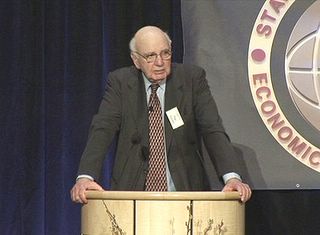 | Click image for video.Former Fed chief Paul Volcker spoke in Feb 2005 at the second annual summit of the Stanford Institute for Economic Policy Research. In his keynote speech he warned that the nation was facing 'huge imbalances and risks'. |
A few selected excerpts:
"Altogether, the circumstances seem as dangerous and intractable as I can remember."
"Boomers are spending like there is no tomorrow."
"Homeownership has become a vehicle for borrowing and leveraging as much as a source of financial security."
"I come now to the heart of the problem, as a Nation we are consuming and investing, that is spending, about 6% more than we are producing. What holds it all together? - High consumption - high leverage - government deficits - What holds it all together is a really massive and growing flow of capital from abroad. A flow of capital that today runs to more than $2 Billion per day."
"What I'm really talking about boils down to the oldest lesson of financial policy in Central Banking: A strong sense of monetary and fiscal discipline."
Fitch Warns on Home Builders
by Calculated Risk on 4/11/2008 02:30:00 PM
From MarketWatch: Fitch warns on darker outlook for home builders
Home builders are facing the twin specters of a slowing U.S. economy and a housing contraction that looks likely to extend through 2008, Fitch Ratings said Friday.Press Release from Fitch: U.S. Housing Contraction Has Legs, Teleconference 4/15 @ 11AM ET
...
"[A] modest recession, declining home prices, tighter mortgage standards even for conventional loans, poor buyer psychology and record levels of new and existing homes for sale will continue to define the current environment for housing."
[said Bob Curran, Fitch's lead home-building analyst]
Following are the details of the teleconference:Might be an interesting conference call.
--Date: Tuesday April 15, 2008
--Time: 11:00 a.m. ET
--Conference ID: 43464842
--U.S/Canada: +1-866-529-2924
Japan's Mizuho: $5.5 Billion in Losses
by Calculated Risk on 4/11/2008 01:49:00 PM
From Reuters: Japan's Mizuho stung by $5.5 billion in subprime pain (hat tip learning james)
Japan's Mizuho Financial Group Inc (8411.T) cut a third off its earnings estimate for the year just ended, stung by $5.5 billion in subprime-related losses, mostly at its brokerage arm.The losses are everywhere - from Wall Street, to a small town in Norway, to banks in Japan.
Goldman Estimates WaMu Losses at up to $23 Billion
by Calculated Risk on 4/11/2008 10:33:00 AM
From Bloomberg: Washington Mutual Falls on Short Sale Recommendation
``Given WaMu's disproportionate exposure to states'' where home prices are forecast to decline, Goldman expects losses between $17 billion and $23 billion, the analysts wrote. Washington Mutual may have a $14 billion provision charge in 2008 ...Yes - a rare 'short sale' recommendation - but what really got my attention was the loss estimate!
Import Prices Jump
by Calculated Risk on 4/11/2008 09:33:00 AM
From the WSJ: Import Prices Show Pervasive Jump, Even When Oil Costs Are Excluded
Import prices surged in March, lifted by not only oil but also the biggest jump in nonpetroleum costs on record, a worrisome sign for inflation.Rising import prices have a somewhat small impact on U.S. inflation, because total imports (about $2.3 trillion in 2007) are relatively small compared to GDP ($13.8 trillion in 2007) - or about 17% of GDP. But the 5.4% increase in import prices does add - as a rough estimate - about 1% to U.S. inflation.
Overall import prices rose 2.8% last month, after increasing an unrevised 0.2% in February, the Labor Department said Friday. ...
During the 12 months since March 2007, prices increased 15%. ...
Excluding petroleum, all other import prices rose 1.1% in March, after increasing 0.7% in February. Prices excluding petroleum increased 5.4% in the 12 months since March 2007, nearly double the 2.8% climb between March 2006 and March 2007.
Also, increases in the trade deficit, associated with rising prices (as opposed to more imported goods and services), is unwelcome news.
The State of the No Down Market
by Anonymous on 4/11/2008 09:05:00 AM
To summarize this MarketWatch article: the parties who are actually in first loss position--whose money is on the table if these things go south--have learned their lesson about no-down financing. The parties who just like to party haven't gotten the memo yet.
Mortgage Guaranty Insurance Corp., for example, changed its guidelines last week to exclude coverage of 100% mortgages. At a minimum, borrowers need a 3% down payment and a credit score of at least 680 to be eligible for coverage. In selected markets where home prices are declining, a 5% down payment is the minimum required. . . .Let us pause just for a moment to reflect on a distinction I haven't posted jillions of words on for a least a year, probably, but that is really crucial here: loss frequency versus loss severity. Requiring a 5% down payment from a borrower is not really about substantially lowering a lender's or insurer's loss severity, or how much you will lose if the thing defaults. It is about substantially lowering loss frequency, or how often defaults occur. This is what the concept of "skin in the game" means: it means having a borrower with a first-loss stake in the deal that is significant, in dollars, to the borrower. A borrower who does not wish to lose a 5% investment in the property, the logic goes, is less likely to "ruthlessly default" immediately should home prices drop; that borrower has some motivation to hang in there until they recover. (And if current prices are still so high that they have a long way to fall and little likelihood of ever recovering, whatever are you doing putting a borrower into such a loan with only 5% down? That's asking for "ruthless default.")
"It's obvious why they're making these changes," [Broker*] Brown said of the insurance companies. "They have to eliminate the losses they're taking." Mortgage insurance companies have been hit hard by the increasing number of defaults and foreclosures, he pointed out.
At MGIC, the changes to underwriting of low loan-to-value loans -- as well as increases to the pricing on some products -- were made due to the recent performance of loans with those characteristics, said Michael Zimmerman, senior vice president of investor relations. But the changes, he said, also reflect a return to more historically normal underwriting standards.
"The more equity that a borrower has -- or, if you will, skin in the game -- in any investment, the more likely they are to have a higher degree of responsibility toward it," he said.
Goldhaber [of Genworth] said that those in the mortgage industry also have a responsibility to put homeowners into the proper mortgage product. These days, it's irresponsible to give people a loan for 100%, he added.
"In soft markets like we have today, with declining home-price appreciation, to put someone in a zero down is really inappropriate," he said. "It's the kind of product choice that gets consumers in trouble."
But the idea here is that the "skin in the game" is significant to the borrower, not representative of the lender's likely loss. If a 95% financed loan defaults tomorrow, even with no change in the home's value, the lender/insurer is still going to lose somewhere in the neighborhood of 20% of the loan amount. Default servicing and foreclosure and resale of REO is expensive, more expensive than that 5% down is going to cover. Down payments in this view of the world are set to "what the borrower can't afford to lose," not "what the lender can't afford to lose." Or again, it is about making defaults less frequent--because borrowers are motivated not to default "optionally"--than about making defaults less severe, although they surely do mitigate severity.
Try telling these mortgage brokers that:
That said, while the conventional no-down-payment products may have disappeared, there are still ways to buy a home without a down payment, said A.W. Pickel, CEO of LeaderOne Financial in Overland Park, Kan., and former president of the National Association of Mortgage Brokers.To quote Professor Krugman, "gurk." It's as if this "conversation" between mortgage insurers and mortgage brokers is happening on two different planets. I have gone on record as being a bit skeptical that "ruthless default" is as widespread as some breathless media stories want to imply--mostly because I suspect that the borrowers in question really can't afford their mortgage payments--but only a fool (which I try not to be) would claim it has never happened and won't keep happening if you put people into "free put option" contracts where there is no financial downside to just walking away from a loan.
"You have to broaden your definition of no-down payment," he said, adding that loan options are available, if not in the form they were in before.
A gift from a family member or a community grant can take the place of a down payment, for example, he said. And down-payment assistance programs are available to help those seeking loans backed by the Federal Housing Administration, he added. . . .
"You will see more unique products coming out," he said, as companies search for ways to help down-payment challenged buyers get into a new home.
But as of now, there are fewer options than there were before for would-be buyers who don't have ample cash reserves. And Brown sees that as an overreaction.
He believes consumers should have the option of financing their entire purchase -- even if it comes with extra fees or higher rates. Someone who doesn't have a lot of cash, but is a good credit risk, for example, should have that option, he said.
And yet here we are, treated to brokers discussing ways borrowers can use OPM (Other People's Money) to leverage 100% financing, even in a falling market, because we can declare them "good credit risks" at the same time we put them in loans that offer no downside to default. What kind of "good credit risks" are these people? Folks who will continue, doggedly, to make mortgage payments on an upside-down property for years and years, unable to move, unable to refinance, all in the name of the sanctity of debt obligations? How, exactly, would any lender or insurer measure this kind of "willingness to repay"? With a FICO? Now that we're being told that many borrowers are keeping up the MasterCard payments--they don't want the downside of having the card cut off--while missing the mortgage payment, because there's little downside there?
There is, of course, one possibility here: we could measure "willingness to repay" by a kind of proxy measure, like, um, "willingness to put one's own money on the table in the form of a down payment." This, however, would involve all of us being on the same planet. And clearly we aren't all there yet.
____________
*Actual title is "a certified mortgage planning specialist"
Thursday, April 10, 2008
Krugman: Crisis "Not Over Yet"
by Calculated Risk on 4/10/2008 05:17:00 PM
 | This is the TED spread for April 10th from Bloomberg. Professor Krugman writes Not over yet "Gurk. The TED spread is up again. So is the LIBOR-OIS spread." |
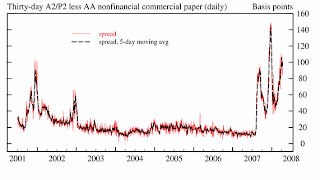 And the A2/P2 spread from the Fed weekly commercial paper is still very high.
No wonder Krugman is worried.
Treasury: On Pace for Record Budget Deficit
by Calculated Risk on 4/10/2008 02:20:00 PM
From AP:
The $10 Trillion man contest is on!
Senate Passes Bill with Builder Tax Breaks
by Calculated Risk on 4/10/2008 01:28:00 PM
From Reuters: Senate backs tax break-focused housing rescue bill
At a cost of $15 billion over 10 years, the Senate bill would give a $6 billion tax break to home builders by temporarily extending a rule that lets businesses count current losses against taxes from prior profitable years.Daniel Gross at Slate wrote about this proposed builder tax break: A Tax Break for Bubble Heads
Home builders such as Pulte Homes and KB Home would benefit from this proposed two-year extension of the net operating loss carry-back rule, according to analysts.
But the House's bill excludes the extension. ...
The Senate bill would also raise the limit on the size of mortgages the Federal Housing Administration may insure, to $550,000, while setting up a $7,000 tax credit, spread over two years, for buyers of homes in or near foreclosure.
"The proposed tax break is hard to justify for several reasons. It does nothing for slow and steady companies that keep their heads and simply rack up profits year after year — and pay their taxes accordingly. Rather, it rewards the most reckless participants in the bubble. If you borrowed a ton of money to build spec houses in Miami and reported $2 billion in profits between 2002 and 2007 but gave up all those profits by notching a $2 billion loss this year, the extended carryback has a great deal of value. If you've been building affordable housing in Wichita, Kan., and booked $300 million in profits in those years, and then, through careful management of costs, managed to eke out a $5 million profit this year, it has no value. The big public homebuilders, whose shares rallied on the news of this potential tax break, didn't pay any windfall taxes on the bubble-era earnings. Why should they get an extraordinary post-bubble windfall?"I'd go a step further: The U.S. has too much home building capacity, and delaying the bankruptcy of some "bubble head" builders will delay the eventual recovery for housing and the economy. Hopefully this provision will be removed from the bill by the House.
...
"The proposal to give new tax breaks to homebuilders and banks is yet another example of the pernicious trend of privatizing profit and socializing losses, which is gnawing away at faith in the system. Dilute the shareholders, not the taxpayers."
February Trade Deficit
by Calculated Risk on 4/10/2008 10:15:00 AM
The Census Bureau reported a goods and services deficit of $62.3 billion for February 2008. Exports, in February, increased almost $3 billion to $151.3 billion, but imports increased by over $6 billion to $213.7 billion - despite petroleum imports being off slightly in February.
Export growth was still strong, but the rise in imports is very disappointing - especially if the increase in imports was due to rising prices (export and import prices will be released tomorrow). Note: we have to be careful to not read too much into one month's data.
This also suggests Q1 GDP will be weaker than currently expected. Click on graph for larger image.
The red line is the trade deficit excluding petroleum products. (Blue is the total deficit, and black is the petroleum deficit). The current probably recession is marked on the graph.
The ex-petroleum deficit has been falling fairly rapidly, almost entirely because of weak imports. Hopefully the increase in February was just monthly noise.



