
 RSS Feed
 by Calculated Risk on 3/16/2008 01:37:00 PM
Sunday, March 16, 2008
WaPo Cartoon on Leverage
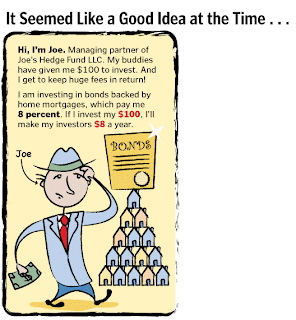 Click on image for full cartoon at the WaPo site.
Here is a simplistic cartoon from the WaPo showing how leverage can boost returns - and can also lead to disaster. How Debt Bites Back (hat tip David).
This cartoon shows leverage of 30 to 1; I think 14 to 1 is more typical.
Using the other numbers in the cartoon, 14 to 1 leverage would result in 36% return from the hedge fund when all is going well (before the hedge fund manager's cut).
And of course a 36% return will attract more investors, and allow the hedge fund to borrow more money (with the same leverage) - and pay the hedge fund manager larger fees. As the cartoon points out, because of the credit issues, this ends up being a losing strategy for investors - but the cartoon misses the final point - this is still a winning strategy for the hedge fund manager!
Back in 2005, Professor Hamilton wrote: Hedge fund risk
Psst-- want to earn a 41% annual return over a decade? Then read on.And when the hedge fund does go under (the low probability event occurs), no one asks the hedge fund manager to return their fees. A short term winning strategy, with "a long-run guaranteed return on investment of -100%", is still a potential winning strategy for a hedge fund manager.
... let me tell you about [a] fund ... called CDP, which was described by MIT Professor Andrew Lo in an article published in Financial Analysts Journal in 2001.
1992-1999 was a good time to be in stocks-- a strategy of buying and holding the S&P 500 would have earned you a 16% annual return, with $100 million invested in 1992 growing to $367 million by 1999. As nice as this was, it pales in comparison to CDP's strategy, which would have turned $100 million into $2.7 billion, a 41% annual compounded return, with a positive return in every single year.
Want to learn more? CDP stands for "Capital Decimation Partners", a hypothetical fund created by Professor Lo in order to illustrate the potential difficulty in evaluating a fund's risk if all you had to go on was a decade of stellar returns. The strategy whereby CDP would have amassed a hypothetical fortune was amazingly simple-- it simply sold put options on the S&P 500 stock index (SPX).
Buying put options is a way that an investor can buy insurance against the possibility of a big loss. For example, the S&P 500 index is currently valued around 1250. You can buy an option (the 1150 March 2006 put) that will pay you $100 for every point that the S&P is below 1150 on a specified date in March. Such an insurance policy would today cost you about $750. If you've bought enough puts to balance the equity you have invested long, you have nothing to fear if the market goes below 1150, because every dollar you lose on your main holdings you can gain back from your put option.
But what about the person who sold you that put? They have now assumed all of your downside risk. Lo's Capital Decimation Partners would use its capital to meet the margin requirements (which guarantee to the exchange that CDP could in fact make the payments to the buyer of the put), and roll over the proceeds to make even bigger bets. Essentially it was thus using leverage to turn the relatively small proceeds from selling these puts into a huge return on the capital invested.
Of course, if you play that game long enough, eventually the market will make a big enough move against you that your capital used to meet margin requirements gets completely wiped out, giving you a long-run guaranteed return on your investment of -100%. But over the 1992-99 period, Lo's hypothetical fund dodged that bullet and ended up turning in a whopping performance.
Lo gives a variety of other examples of funds that could go for a long period with very high returns and yet entail enormous risks. They all have this feature of pursuing investments that have a high probability of a modest return and a very small probability of a huge loss. By leveraging such investments, one can achieve a very impressive record as long as that low probability disastrous event does not occur.
MMI: We're All Icebergs Now
by Anonymous on 3/16/2008 11:00:00 AM
Dr. Krugman has inspired me to get back to the Muddled Metaphor Index. Longtime readers will know that the MMI emerged last summer as one of our blog's tools for measuring distress in the credit markets. The MMI is calculated by plotting the disintegration of metaphoricity in reports of credit market events against the general unwillingness to recognize reality until it bites you on the shoulderblade, and then chortling over the results. Some people question the science here, but we tell them to go jump in a desert.
Today's text is the reliable New York Times on Thornburg Mortgage's problems. Personally, the thing I like best about this article is that it makes no sense whatsoever to anyone who doesn't already know what Thornburg's business plan is. You imagine the average reader asking: so if Thornburg doesn't make these "Ninja" loans, how come they own all these securities full of them? The term "leverage" haunts the article like an elusive ghost that hints at a sinister presence but never quite fully materializes. That's because the whole thing just begs for another awkward metaphor to be piled on.
There are in fact several gems here:
Thornburg already had one near-death experience last summer, when the mortgage crisis first hit and its shares plunged. Racing from interview to interview, and huddling with investors and analysts, Mr. Goldstone managed to convince the market that his company could survive. He even managed to raise more than $500 million in fresh capital from investors.Yeah, it was all so precipitous. Unless you're some blogger who has been harping on the looming Alt-A problem for a year or so. Then it's more like a--oh, no, not a--AAACK!---
This time, though, the outlook is more dire.
Specifically, the problem concerns Alt-A securities, an obscure part of the mortgage debt market that may soon become as familiar as the now-infamous subprime category. Thornburg holds billions in securities backed by Alt-A mortgages, which were considered safer than subprime but not rock solid.
Alt-A (short for Alternative-A) borrowers typically had good credit scores but lacked the documentation to lift them into the prime category.
“Alt-A has been the precipitating event; it’s just been feeding on itself,” Mr. Goldstone says. “You have AAA-rated mortgage securities trading with junk bond yields. That makes no sense.”
The story of Alt-A and Thornburg also illustrates why the current credit crisis is different from past panics, like the market crash of 1987 or the crisis a decade ago when Long-Term Capital imploded. Those were rapid-paced events, which erupted and then faded from view. This is more akin to a slow-motion, chain-reaction car crash.Whew. I was just sure it was gonna be a train wreck, and I don't think I can handle any more of those. But of course it's like a car crash in the ocean:
IN other words, this isn’t the tip of the iceberg; it’s another iceberg entirely.So it's a precipitous event that is also slow-motion, a chain-reaction like hitting one iceberg and almost going to the bottom but not quite and then sailing on for a while until you hit a different iceberg because after having hit the first iceberg you are still convinced that those little bitty chunks of ice floating on the waves don't have great big honkin' bergs under the surface because, like, how often does that happen?
And as Mr. Goldstone can tell you, few can predict who will be the next to feel the impact.Um. Few complete uninformed idiots could predict this. I'd guess that an entire troop of moderately alert cub scouts could go take a look at some financial statements to see who else is overleveraged in the Alt-A sector and make a couple of pretty solid predictions, myself.
Whocoodanode? is alive and well.
Saturday, March 15, 2008
Bear Stearns Saturday Update
by Calculated Risk on 3/15/2008 09:13:00 PM
Charlie Gasparino at CNBC reports: Bear Stearns Weekend Talks Reveal 2 Key Contenders (hat tip risk capital)
... potential bidders for Bear have been narrowed to ... J.C. Flowers and JPMorgan Chase
... bankers have now come to the conclusion that a deal must be done by Monday ...
If there's no deal Bear Stearns will have to file for bankruptcy, executives said.
Trade Deficit and Mortgage Equity Withdrawal
by Calculated Risk on 3/15/2008 05:07:00 PM
The following graph shows an interesting relationship (Caution: correlation doesn't imply causation!). As Mortgage Equity Withdrawal (MEW) rose, so did the trade deficit. Note: both are shown as a percent of GDP.
Now that MEW is falling, the trade deficit is also falling - especially if we exclude petroleum imports. Click on graph for larger image.
The dashed green line is the Kennedy-Greenspan MEW estimates as a percent of GDP.
Clearly the housing bust led to less MEW, and less MEW might have contributed to the declining trade deficit. (Something I predicted in 2005).
Looking forward, it appears MEW will decline sharply in 2008, as housing prices decline further, lending standards are tightened, especially for HELOCs, and since homeowner percent equity is already at record lows. In other words, the Home ATM is closing.
This suggests that the trade deficit (especially ex-petroleum) might decline sharply too. Part of the decline in the trade deficit is related to the falling dollar and higher U.S. exports (See Krugman's Good news on the dollar)
However, to complete the global rebalancing, two things must happen: both petroleum imports (in dollars) and the deficit with China must decline. The good news is the January trade deficit with China - although still huge at $20.3 billion - was actually less than the $21.3 billion in January 2007. The bad news is oil imports (in dollars) were at record levels.
Unless we see these key components of the trade deficit start to decline (oil and China), other exporters to the U.S. will have to bear the burden of the possibly sharp rebalancing of global trade.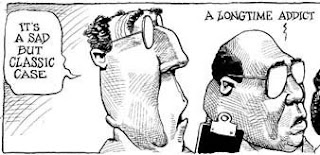
Added: On oil, here is a KAL's cartoon from the Economist:
Click on image to see cartoon at The Economist.
The Economics of Trust
by Anonymous on 3/15/2008 09:30:00 AM
Yves at naked capitalism has a great post up this morning on Character and Capitalism. I strongly recommend Yves' post and the Steve Waldman post as well.
Two anecdotes to add to the mix: back in the 90s I found myself at some manager compliance training session at my stuffy regional midwestern bank. The compliance officer was talking about the corporate policy of running credit reports on job applicants. The rationale was that, well, you don't hire people to handle other people's money all day if you have reason to believe they are personally desperate for money.
The human resources manager was there, and at that point she let out a loud uncontrollable guffaw. Challenged, she responded that yes, the HR department does order the credit reports as policy requires. They put them in the file, as policy requires, and get on with hiring people anyway. "Are you aware," she asked the compliance officer, "what we pay tellers and accounting clerks? If we didn't hire people who really needed the money, we wouldn't have anyone to hire."
A few years later I was in some meeting of the CRA Committee (Community Reinvestment Act), wherein we were examining the proposed guidelines for a low-income lending initiative. There was some resistance to the loan program based on the fact that borrowers with incomes as low as 50% of the area median could qualify. Grumbling about having to make loans to "poor people" ensued. My boss pointed out that over half the rank and file in his department who would be actually handling these loans--reviewing the loan files, preparing them for the servicing system, delivering them to custodians and investors--were paid 50% of the area median or less. Henry Ford might have figured out many decades ago that you need to pay your workers enough that they can buy your product, but that lesson was lost on the banks.
Friday, March 14, 2008
WSJ on Bear Stearns
by Calculated Risk on 3/14/2008 10:15:00 PM
The WSJ has several followup articles on Bear Stearns. The first provides an excellent summary of the events leading up to the bailout. See WSJ: Fed Races to Rescue Bear Stearns In Bid to Steady Financial System
The story discusses how Bear Stearns, JPMorgan and the Fed regulators worked around the clock Thursday night to put together the bailout.
At about 5 a.m. Friday, regulators including New York Fed Chief Timothy Geithner, Federal Reserve Chairman Ben Bernanke, Treasury Secretary Henry Paulson and the Treasury under secretary domestic finance, Robert Steel, convened by conference call. At the end of the call at 7 a.m., the Fed had decided it would offer the loan.A fascinating story.
The second key story suggests Bear Stearns will probably be sold within days. See the WSJ: It Is Tough to Value Bear, But It Had Better Sell Fast
Joint Venture Involving Major Homebuilders in Default
by Calculated Risk on 3/14/2008 07:36:00 PM
From the WSJ: Two Projects in Default Dog Big Home Builders
Two massive housing developments in Las Vegas, involving several of the nation's largest home builders, have received default notices on about $765 million in debt ... two joint ventures, involving builders Toll Brothers Inc., KB Home and Lennar Corp. among others, have each missed an interest payment in recent weeks ...Earlier this week, in a filing with the SEC, Toll warned of potential "significant losses" from joint ventures projects:
We have investments and commitments to certain joint ventures with unrelated parties to develop land. These joint ventures usually borrow money to help finance their activities. In certain circumstances, the joint venture participants, including ourselves, are required to provide guarantees of certain obligations relating to the joint ventures. As a result of the continued downturn in the homebuilding industry, some of these joint ventures or their participants have or may become unable or unwilling to fulfill their respective obligations. In addition, we may not have a controlling interest in these joint ventures and, as a result, we may not be able to require these joint ventures or their participants to honor their obligations or renegotiate them on acceptable terms. If the joint ventures or their participants do not honor their obligations, we may be required to expend additional resources or suffer losses, which could be significant.
A Bear Market?
by Calculated Risk on 3/14/2008 05:51:00 PM
The general definition of a bear market is a 20% decline in the major indexes over a several month period.
The S&P 500 peaked at 1565.15 (closing) on October 9, 2007.
As of today, the S&P 500 is off 17.7%; not quite a Bear market.
And no bank failures today ... so here is a song for Friday afternoon.
"The U.S. dollar is worthless,
I've got the Ben Bernanke Blues."
Bernanke on Fostering Sustainable Home Ownership
by Calculated Risk on 3/14/2008 01:53:00 PM
From Fed Chairman Ben Bernanke: Fostering Sustainable Home Ownership.
Bernanke discusses the strong correlation between house price declines and mortgage delinquencies.
Mortgage performance data show a strong correlation between adverse house price changes and subsequent increases in mortgage delinquency and foreclosure (Avery, Brevoort, and Canner, 2007; Gerardi, Shapiro, and Willen, 2007). Investors who purchased homes in the hope of price appreciation seem particularly likely to walk away from "underwater" mortgages. Indeed, the role of investors in the housing market has increased markedly over time. According to data collected under the Home Mortgage Disclosure Act (HMDA), lending to non-owner-occupants has risen from about 5 percent of the home-purchase loans in the mid-1990s to about 17 percent of all purchases in 2005 and 2006 (Avery, Brevoort, and Canner, 2007). Mortgage delinquencies are also tied to local economic conditions; notably, several midwestern states struggling with job losses and slow income growth have seen increased delinquencies.The situation is not contained to subprime:
The current high rate of delinquencies and foreclosures is not confined to the subprime market. In 2007, about 45 percent of foreclosures were on prime, near-prime, or government-backed mortgages.And on negative externalities of foreclosure:
There is also work to be done in mitigating the impact of unavoidable foreclosures on consumers and communities. Families who cannot sustain homeownership will need to find new places to live, highlighting the critical need for an adequate supply of affordable rental housing. Consumers going through foreclosure typically will see their credit scores drop, raising longer-term questions about their ability to rebound financially and perhaps pursue a more sustainable home purchase at some later point. High numbers of foreclosed homes in some communities also raise challenges, and perhaps opportunities. Because vacant homes, in particular, impose real costs on neighborhood and communities, forward-looking strategies to keep these homes occupied are important (Apgar and Duda, 2005).There is much more in Bernanke's speech.
And talking about sustainable homeownership:
 Click on graph for larger image.
The Census Bureau recently reported that the homeownership rate declined to 67.8% in Q4, from 68.2% in Q3 2007.
The homeownership rate has plunged back to the levels of the summer of 2001. Note: graph starts at 60% to better show the change.
Fed: "Will continue to provide liquidity as necessary"
by Calculated Risk on 3/14/2008 11:22:00 AM
From the Federal Reserve:
The Federal Reserve is monitoring market developments closely and will continue to provide liquidity as necessary to promote the orderly functioning of the financial system. The Board voted unanimously to approve the arrangement announced by JPMorgan Chase and Bear Stearns this morning.Another day, another Fed statement.



