
 RSS Feed
 by Calculated Risk on 11/30/2007 04:31:00 PM
Friday, November 30, 2007
Moody's Takes Rating Action on SIVs
UPDATE: Here is the Bloomberg story: Moody's Says Citigroup SIV Debt Ratings Under Threat (hat tip CBam)
From Reuters: Moody's cuts or may cut over $100 billion of SIV debt
Moody's pointed to continued decline in the value of the investments made by structured investment vehicles, or SIVs, in downgrading or issuing warnings for about $116 billion of their debt.From Moody's (no link)
"The situation has not yet stabilized and further rating actions could follow," Moody's said in a news release.
...
Given the continued decline in SIV asset values, Moody's said it is now expanding its review, which is not complete, to include the senior debt of some vehicles.
London, 30 November 2007 -- Moody's Investors Service announced today that it has completed part of its review of the SIV sector. This review was prompted by the continued market value declines of asset portfolios. Moody's confirmed, downgraded, or placed on review for possible downgrade, the ratings of 79 debt programmes (with a total nominal amount of approximately US$130 billion). This action affects 20 SIVs as described below.
Moody's has completed its review of capital notes started on November 7th. The significant additional deterioration in market value of assets across the SIV sector observed since November 7th has resulted in the expansion of Moody's original review to include the senior debt ratings of some vehicles. Moody's will continue to closely monitor SIV ratings, taking actions on individual vehicles as warranted.
In its monitoring of SIV ratings, Moody's pays particular attention to the evolving liquidity situation of each vehicle, changes in portfolio market value, and the vehicle's prospects for restructuring.
Rationale for Rating Actions
In recent weeks, Moody's has observed material declines in market value across most asset classes in SIV portfolios. These asset classes include Financial Institutions, which represent, on average, 38% of SIV portfolios, ABS 16%, CDOs 12% (including CDOs of ABS 1.4%). Financial Institutions debt suffered an average price decline of 1.6% from October 19th to November 23rd, ABS 0.7%, CDOs (excluding CDOs of ABS) 0.5%, and CDOs of ABS 22%. Furthermore, the continued inability to issue or roll Asset Backed Commercial Paper (ABCP) or Medium Term Notes (MTNs) causes mark-to-market losses to be realised when assets are liquidated to meet maturing ABCP and MTNs.
In this latest review, Moody's employed its updated methodology as announced on September 5th. The methodology update reflects the unprecedented volatility in the market value of the securities held by SIVs. For each SIV, Moody's models expected loss using a stressed volatility for the distribution of market asset prices based primarily on declines observed since July 2007. With this stress, only those tranches of the ABCP and MTNs issued that can sustain an additional price decline of two times the decline observed in this period will retain Aaa/Prime-1 ratings.
For example, if the net asset value of a SIV (measured as the difference between portfolio market value and the notional value of senior liabilities, expressed as a percentage of paid-in capital) was par in July and declined 30% to a current value of 70%, Moody's assumes that the probability of a deterioration in net asset value by an additional 60% of par to levels below 10% is negligible and is therefore consistent with a Aaa probability of default. Moody's analysis therefore assumes that all asset prices may move in a highly correlated manner. In addition, in Moody's stress analysis of the senior debt, Moody's reduced its estimate of current net asset value of all SIVs by 10-15 percentage points to reflect uncertainty in the ability to execute trades at current market quotes given continued NAV declines.
In modelling both senior and capital notes, Moody's extended its analysis by including the potential benefits of refinancing maturing senior debt using repurchase agreements. Moody's assumes that a vehicle that is able to replace maturing senior funding by repo funding continues to do so until an optimal level of repos is attained; the vehicle then enters into wind-down mode and, for the purpose of our analysis, liquidates its assets at distressed levels in order to satisfy noteholders.
Conclusions and Outlook
Moody's has taken rating actions as a result of deteriorating credit and other market conditions. It appears that the situation has not yet stabilised and further rating actions could follow. As with previous actions, the rating actions Moody's has taken today are not a result of any credit problems in the assets held by SIVs, but rather a reflection of the continued deterioration in market value of SIV portfolios combined with the sector's inability to refinance maturing liabilities.
Montana Fund Withdrawals
by Calculated Risk on 11/30/2007 01:40:00 PM
From MarketWatch: Florida's investment woes spark subprime fears in other states
Florida halted withdrawals from a $15 billion local-government fund on Thursday after concerns over losses related to subprime mortgages prompted investors to pull roughly $10 billion out of the fund in recent weeks.In addition to potential "bank runs" on these funds, another key concern is if other funds stop investing in asset backed CP - making the credit crunch worse.
Other states are experiencing similar problems on a smaller scale.
The Montana Board of Investments, which manages the state's money, has seen $247 million withdrawn by local governments in the past three days from a $2.5 billion money-market-like fund called the Short Term Investment Pool.
"We've had some local government withdrawals in the past few days because of reports about Florida's problems," Carroll South, executive director at the Montana Board of Investments, said in an interview on Thursday.
Rating agency Standard & Poor's warned last month that it could downgrade a $4.8 billion investment pool run by King County, Wash., because of potential subprime exposures.
Where is Moe?
by Calculated Risk on 11/30/2007 11:24:00 AM
That was my reaction to the Bernanke and Paulson show. I thought there were three stooges!
Seriously, the best take on the Paulson freeze proposal was Tanta's letter: Dear Mr. Paulson.
The industry is telling you right now that they just don't have enough people with the right skills to be able to wade through all the problem (or potential problem) loans fast enough to make the workout/foreclose decision.Since the industry lacks the infrastructure to handle the work load, it makes sense to have some sort of guideline to decide which loans to foreclose on now, and which loans to foreclose on later. Think of it as a mortgage triage protocol. And helping to craft these guidelines is a reasonable role for government. So kudos to Paulson (even if we have to put up with some silly PR).
The industry group name is hilarious too: "Hope Now Alliance". That reminds me of SEC Director Erik Sirri's comment earlier this week: "Hope is a crappy hedge".
As far as Chairman Bernanke, his concern that the stock market is off 5% or so from the recent high is touching:
The fresh wave of investor concern has contributed in recent weeks to a decline in equity values ...This comment strikes me as irresponsible given the concern over the "Bernanke Put", speculation and moral hazard. The Fed's asymmetrical response to asset bubbles is an interesting discussion, but concern over a 5% or 10% decline in the stock market? Come on.
Finally, we all know the Fed is going to cut rates in December. While the Fed was talking tough, the market was debating the size of the rate cut. And that makes it seem as if Bernanke is behind the curve.
I'm still looking for Moe.
Construction Spending Declines
by Calculated Risk on 11/30/2007 10:14:00 AM
From the Census Bureau: October 2007 Construction Spending at $1,158.3 Billion Annual Rate
Spending on private construction was at a seasonally adjusted annual rate of $863.2 billion, 1.4 percent (±1.1%) below the revised September estimate of $875.2 billion. Residential construction was at a seasonally adjusted annual rate of $503.7 billion in October, 2.0 percent (±1.3%) below the revised September estimate of $514.2 billion. Nonresidential construction was at a seasonally adjusted annual rate of $359.4 billion in October, 0.5 percent (±1.1%)* below the revised September estimate of $361.1 billion.Further declines in residential construction is widely expected, but also note the small decline in private nonresidential construction spending.
 Click on graph for larger image.
The graph shows private residential and nonresidential construction spending since 1993.
Over the last couple of years, as residential spending has declined, nonresidential has been very strong. But it now appears that nonresidential construction may be slowing. This is just one month of data, and one month does not make a trend, but there is other evidence - like the Fed's Loan Officer Survey - that suggests a slowdown in nonresidential has arrived.
Thursday, November 29, 2007
The Run on Florida’s Local Government Investment Pool
by Calculated Risk on 11/29/2007 08:43:00 PM
On Nov 15th David Evans at Bloomberg wrote: Public School Funds Hit by SIV Debts Hidden in Investment Pools
What ... municipal finance managers ... across the country still haven't been told -- is that state-run pools have parked taxpayers' money in some of the most confusing, opaque and illiquid debt investments ever devised.This story led to a run on the fund, and Evans wrote today: Florida Halts Withdrawals From Local Investment Fund
These include so-called structured investment vehicles, or SIVs, which are among the subprime mortgage debt-filled contrivances that have blown up at the biggest banks in the world.
Florida officials voted to suspend withdrawals from an investment fund for schools and local governments after redemptions sparked by downgrades of debt held in the portfolio reduced assets by 44 percent.Before the run, the fund had $27 Billion in assets, and the fund was frozen today with $15 Billion remaining.
The Florida LGIP had strict investment guidelines, but unfortunately the guidelines allowed investment in asset backed commercial paper (CP) backed by prime and Alt-A mortgages.
A small percentage of the fund's investments have been downgraded and no longer meet the guidelines of the fund.
 Click on chart for larger image.
This chart shows the investments that have been downgraded below the standards of the fund. This chart shows losses of about $45 million; not much for a $27 Billion fund (0.17%). Of course with each redemption at par (the run on the fund), the percentage losses for the remaining funds grow. $45 million for a $15 Billion fund is 0.3%. Considering the fund was paying investors 5.77%, even a 0.3% loss is not horrible.
However there are serious questions about the investment decisions of the pool. And there are other investments that could go bad. As an example the Fund invested $650 million in certificates of deposit in Countrywide Bank - with the recent redemptions that investment now amounts to over 4% of the pool's assets - and there is some risk that Countrywide could go under.
The two main concerns are: 1) Will there be a run on other investment pools? and 2) If other funds stop investing in asset backed CP, this might further the credit crunch and increase spreads for other products.
ETrade ABS Haircuts
by Calculated Risk on 11/29/2007 07:26:00 PM
Brian has dug up the value of the ETrade ABS as of Sept 30, 2007. The assets included a substantial amount of prime residential first liens.
Here is Brian's spreadsheet: Etrade Haircut Spreadsheet
He would appreciate comments on the haircuts.
The importance of these marks can't be overstated.
From Dow Jones: E*Trade's CDO Sale May Mean Lower Values For Bank Holdings (no link yet)
Hedge fund Citadel Investment Group's agreement to buy a troubled debt portfolio from E*Trade Financial Corp. ... could be bad news for banks still holding similar securities on their books.
Banks like Citigroup ... and Merrill Lynch ... "mark to model" approach produced some $36 billion in losses for banks in the third quarter ... The E*Trade deal, however, could show that losses have been worse. The discount broker sold Citadel its $3 billion portfolio of asset backed securities ... at a cut-rate price of around 27 cents on the dollar.
Florida REO: Priced Below 2002 New Home Price
by Calculated Risk on 11/29/2007 05:35:00 PM
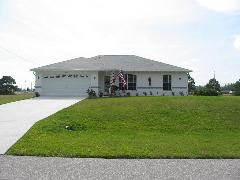 The asking price for this foreclosed property in Florida is below the price the home sold for new in 2002. (hat tip John)
Here are the details:
Feb 15, 2002: $122,300 (New)
Mar 15, 2006: $259,600
Oct 23, 2007: Foreclosed.
Current Asking Price: $99,900
There are probably some special circumstances with this house, but ... yikes! According to the public tax records, the larger house on the 2nd lot away sold for $185,300 new in 2004, and for $370,000 in 2006.
This raises some interesting questions: How far have prices really fallen?
How will the neighbors react when they discover their homes are worth far less than they paid in recent years?
As OFHEO noted today:
Declines in home prices will increase the frequency with which homeowners find themselves with no equity and thus may be motivated to “walk away” from the property and the mortgage.No kidding - this has to be depressing for the neighbors. Note: I rarely mention Florida, but this is worth noting.
Florida Freezes Fund Withdrawals
by Calculated Risk on 11/29/2007 04:16:00 PM
UPDATE: This Bloomberg Special Report has more info: Florida Suspends Withdrawals From Investment Pool (hat tip Andrew)
The pool had $3 billion of withdrawals today alone, putting assets at $15 billion, said Coleman Stipanovich, executive director of the State Board of Administration. The board manages the pool along with other short-term investments and the state's $137 billion pension fund.Original post from the WSJ: Florida Moves to Halt Run on Fund
``If we don't do something quickly, we're not going to have an investment pool,'' said Stipanovich at the meeting in the state capitol in Tallahassee. The fund was the largest of its kind, managing $27 billion before this month's withdrawals.
Local governments including Orange County and Pompano Beach that use the pool like a money-market fund asked for their money back after the State Board of Administration disclosed in a report earlier this month that holdings in the fund were lowered to below investment grade.
...
The pool has invested $2 billion in structured investment vehicles and other subprime-tainted debt, state records show. About 20 percent of the pool is in asset-backed commercial paper, Stipanovich said at the meeting today.
``There is no liquidity out there, there are no bids'' for those securities, he said.
Florida halted withdrawals from a $15 billion local-government fund Thursday after concerns over losses ... prompted investors to pull roughly $10 billion out of the fund in recent weeks.
The State Board of Administration met Thursday and voted to immediately freeze withdrawals ...
The decision shows how far this year's ... credit crisis has spread. Florida's Local Government Investment Pool, which had more than $27 billion in assets at the end of September, is a money-market fund that's supposed to invest in ultrasafe assets to provide participants with a secure place to stash spare cash. But even these types of funds have been hit by the widening crunch.
House Prices and Foreclosures
by Calculated Risk on 11/29/2007 02:34:00 PM
OFHEO provides a discussion of foreclosures and house prices in the Q3 House Price Index report.
The causal relationship between home prices and foreclosures is two-directional: high foreclosure activity can both cause and be caused by home price declines. Home price declines can cause foreclosures by decreasing the equity homeowners have in their properties. Mortgagors are much more likely to default on their loans if the current value of their property falls below the outstanding loan balance (i.e., their equity is zero or less). Declines in home prices will increase the frequency with which homeowners find themselves with no equity and thus may be motivated to “walk away” from the property and the mortgage.Historically foreclosure activity peaks when prices bottom. The following graph shows this relationship for California.
Home foreclosures contribute to weakening prices by introducing additional supply to the inventory of unsold homes. Compounding this influence is the fact that the sellers of foreclosed homes, frequently creditors, may be strongly averse to holding onto the property for an extended period of time. As a result, they may be willing to sell for lower prices than resident homeowners.
 Click on graph for larger image.
In the '90s, as prices fell in California, foreclosure activity (using Notice of Defaults NODs) increased. Prices bottomed in 1996, as foreclosure activity peaked.
Now imagine what will happen over the next few years as house prices fall. Foreclosure activity is already at record levels (2007 estimated on graph). Yet, as prices fall, foreclosure activity will probably continue to increase - the activity will be literally off the chart!
Back to OFHEO:
The upshot of the interrelatedness of foreclosures and house price changes is that the empirical evidence should reveal sharp differences in measured appreciation for states and cities with higher foreclosure rates. ...

Figure 1 plots recent appreciation rates and foreclosure filings by state since the third quarter of 2006. The bars reflect the relative intensity of foreclosure activity for states, where intensity is defined as the ratio of statewide foreclosure filings to the number of households. The blue squares show house price appreciation between the third quarters of 2006 and 2007. OFHEO’s “purchase-only” price index, which is constructed exclusively with sales price data, is used to estimate price changes.OFEHO's conclusion on house prices and foreclosure:
The graph clearly depicts the negative correlation over the latest year. With few exceptions, states with the lowest appreciation (i.e., greatest depreciation) tended to have the most foreclosure filings. For instance, Nevada had by far the greatest relative foreclosure activity and, at the same time, showed the third largest price decline. By contrast, states with relatively few foreclosure filings, including the Dakotas and Vermont, had relatively strong price growth of between 5 and 6 percent.
In conclusion, it should be recognized that house prices are very hard to track in housing market downturns. Empirical evidence has consistently shown that homeowners are hesitant to sell their homes for losses, often leaving their homes on the market for long periods awaiting the “right” price. Price declines may appear muted, as inventories of for-sale properties grow sharply and the properties that do sell may not fully reflect price declines that have occurred. In this environment, if the inventory of unsold properties is relatively large in high-foreclosure areas, then it may take some time for the association between foreclosures and price trends to reveal itself within cities. The best empirical estimates will only become available after the market normalizes and excess inventory has been sold.Translation: There are large price declines coming.
MGIC Tightens Alt-A
by Anonymous on 11/29/2007 12:45:00 PM
AP, via our Clyde:
MILWAUKEE (AP) -- The nation's leading mortgage insurer, MGIC Investment Corp., says it will raise prices and limit its coverage of loans made without proof of income to try to rein in growing losses. . . .You know, I actually believe that MGIC always thought stated income for wage earners was silly.
One of the bigger changes proposed announced Wednesday will limit the insurance MGIC offers people who have Alt-A loans, which generally require only limited verification of income.
MGIC will insure these loans only for people who are self-employed, the original market for them, Culver said. They have been used more recently by people who wanted to borrow more than they could really afford, resulting in losses for MGIC and other mortgage insurers, he said.
"We always thought it was silly, a wage earner who could show you a paycheck would pay a higher interest rate not to show you their paycheck," he said.
The company will raise prices on Alt-A loans, other loans worth 95 percent of a home's value and certain loans for people with low credit scores or small down payments. More specifics will be announced next week, Culver said.
What is missing here is the explanation for why they went ahead and insured something this "silly."



