
 RSS Feed
 by Calculated Risk on 9/19/2007 09:54:00 AM
Wednesday, September 19, 2007
NY Times: TimesSelect is now Free
The NY Times is no longer charging for TimesSelect, and their archives are available free back to 1987.
We have ended TimesSelect. All of our Op-Ed and news columns are now available free of charge. Additionally, The New York Times Archive is available free back to 1987.The NY Times archive is a great resource.
Also, economist Paul Krugman has started his own blog: The Conscience of a Liberal.
Housing Starts and Completions for August
by Calculated Risk on 9/19/2007 09:21:00 AM
The Census Bureau reports on housing Permits, Starts and Completions.
Seasonally adjusted permits fell sharply:
Privately-owned housing units authorized by building permits in August were at a seasonally adjusted annual rate of 1,307,000. This is 5.9 percent below the revised July rate of 1,389,000 and is 24.5 percent below the revised August 2006 estimate of 1,731,000.Starts declined:
Privately-owned housing starts in August were at a seasonally adjusted annual rate of 1,331,000. This is 2.6 percent below the revised July estimate of 1,367,000 and is 19.1 percent below the revised August 2006 rate of 1,646,000.And Completions declined slightly:
Privately-owned housing completions in August were at a seasonally adjusted annual rate of 1,523,000. This is 0.2 percent below the revised July estimate of 1,526,000 and is 19.0 percent below the revised August 2006 rate of 1,881,000.
 Click on graph for larger image.
Here is a graph of starts and completions. Completions follow starts by about 6 to 7 months.
My forecast is for starts to fall to around the 1.1 million units per year level; a substantial decline from the current level. Goldman Sachs' forecast is for 1.1 million units, and UCLA is for 1.0 million units.
Even with the declines in permits and starts, this report shows builders are still starting too many projects. Starts will probably fall much further incoming months.
Tuesday, September 18, 2007
Gross, Rosenberg on the Fed and Rates
by Calculated Risk on 9/18/2007 08:29:00 PM
Update: From the Financial Times: Bank acts boldly to avert recession risk (hat tip Steve)
David Rosenberg, chief economist at Merrill Lynch, said it was hard to combat a deflating credit and asset bubble. He said that while markets soared when the Fed cut rates by 50 basis points in January 2001, they soon fell back.The S&P 500 closed at 1,276.05 on January 2nd, 2001. The Fed cut rates 50bps on Jan 3rd. The S&P 500 closed at 1,347.56, up 5.6% for the day. Then the market started to sell off, falling almost 20% by March. Rosenberg is correct (doesn't mean history will repeat).
Bloomberg video has several interviews concerning the Fed rate cuts. Here is PIMCO's Bill Gross:
| Gross of Pimco Sees 3.75% as `Destination' for Fed Rate September 18 (Bloomberg) -- Bill Gross, manager of the world's biggest bond fund at Pacific Investment Management Co., talks with Bloomberg's Michael McKee from Newport Beach, California, about today's decision by the Federal Reserve to lower its benchmark interest rate by a half point to 4.75 percent, the first cut by the central bank in four years. (Source: Bloomberg) |

Rate Cut Reactions
by Calculated Risk on 9/18/2007 04:26:00 PM
The reactions to the Fed funds rate cut are extremely varied - from relief to outrage. Here are a couple excerpts from the WSJ: Economists React: ‘One and Done’?
The FOMC makes it sound like “one and done” as it cuts both the Fed funds and discount rate by 50 basis points but continues to note inflation risks… As of this writing, we no longer look for the Fed to cut rates in October but that position, like the Fed’s, remains data dependent. –Drew Matus, Lehman BrothersAnd outrage:
Today’s irresponsible 50 basis point reduction is really just the hair of the dog that bit us and is a tacit admission that our economy is addicted to cheap money… A Fed bailout in the form of rate cuts will neither prevent the recession nor keep house prices from collapsing. It may slow the process down a few quarters, but it will cost us dearly. –Peter Schiff, Euro Pacific Capital
Fed Funds Rate Cut: Watch Long Rates
by Calculated Risk on 9/18/2007 02:49:00 PM
Virtuous cycle and vicious cycle:
In many parts of economics there is an assumption that a complex system of determinants will tend to lead to a state of equilibrium. When this tendency is absent terms like virtuous circle and vicious circle (or virtuous cycle and vicious cycle) to describe these unstable pattern of events are used. Both circles are complexes of events with no tendency towards equilibrium (at least in the short run). Both systems of events have feedback loops in which each iteration of the cycle reinforces the first (positive feedback). The difference between the two is that a virtuous cycle has favorable results and a vicious cycle has deleterious results. These cycles will continue in the direction of their momentum until an exogenous factor intervenes and stops the cycle.Perhaps, during the housing boom, a Virtuous Cycle was present as depicted in the following diagram:
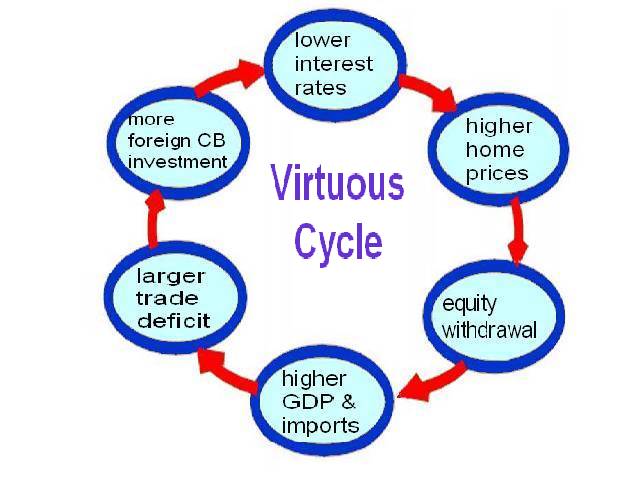 Click on diagram for larger image.
Starting from the top (during the housing boom): Lower interest rates led to an increase in housing prices. And those higher housing prices led to ever increasing mortgage equity withdrawal (MEW) by homeowners.
A large percentage of this equity withdrawal flowed to consumption, increasing both GDP and imports during the boom years. There is a strong correlation between the trade deficit and mortgage equity withdrawal, and although correlation doesn't imply causation, it appears mortgage equity withdrawal was a meaningful contributor to the widening trade and current account deficits during the housing boom.
To finance the current account deficit, foreign Central Banks (CBs) invested heavily in dollar denominated securities. Some analysts have suggested that these investments lowered interest rates by between 40 bps and 200 bps (Roubini and Setser: "Will the Bretton Woods 2 Regime Unravel Soon? The Risk of a Hard Landing in 2005-2006")
If these analysts are correct, and foreign CB intervention lowered treasury yields, then this also lowered mortgage interest rates ... and the cycle repeated. The result: a Virtuous Cycle with higher housing prices, more consumption and lower interest rates.
Now that the housing cycle has broken, what happens next?
The Vicious Cycle
The following diagram depicts the possible unwinding of the virtuous cycle.
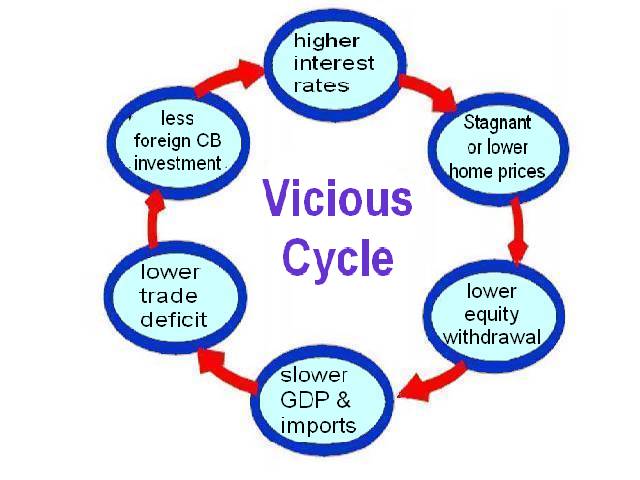
As housing cools down (prices do not need to collapse), mortgage equity withdrawal declines. Then less MEW leads to a slow down in GDP growth and lower imports.
Lower imports might lead to a lower trade deficit, depending on the strength of exports. This could lead to less foreign CB investment in dollar denominated assets. And this could lead to higher interest rates followed by even lower housing prices and the cycle repeats.
The result: a Vicious Cycle with lower housing prices, less consumption leading to higher interest rates.
House prices are now falling. MEW is now falling. And the trade deficit is falling. And the LIBOR rate has increased.
An increase in long rates would be normal if the market expectations for the economy improve. What would be concerning is if long rates increased by more than normal because of the unwinding of investments by foreign CBs. This could lead - for the short term - to a vicious cycle as depicted in the second diagram.
Fed Cuts Rates 50bps
by Calculated Risk on 9/18/2007 02:15:00 PM
Fed Statement (FOMC site swamped, hat tip az_mtb):
The Federal Open Market Committee decided today to lower its target for the federal funds rate 50 basis points to 4-3/4 percent.
Economic growth was moderate during the first half of the year, but the tightening of credit conditions has the potential to intensify the housing correction and to restrain economic growth more generally. Today’s action is intended to help forestall some of the adverse effects on the broader economy that might otherwise arise from the disruptions in financial markets and to promote moderate growth over time.
Readings on core inflation have improved modestly this year. However, the Committee judges that some inflation risks remain, and it will continue to monitor inflation developments carefully.
Developments in financial markets since the Committee’s last regular meeting have increased the uncertainty surrounding the economic outlook. The Committee will continue to assess the effects of these and other developments on economic prospects and will act as needed to foster price stability and sustainable economic growth.
Voting for the FOMC monetary policy action were: Ben S. Bernanke, Chairman; Timothy F. Geithner, Vice Chairman; Charles L. Evans; Thomas M. Hoenig; Donald L. Kohn; Randall S. Kroszner; Frederic S. Mishkin; William Poole; Eric Rosengren; and Kevin M. Warsh.
In a related action, the Board of Governors unanimously approved a 50-basis-point decrease in the discount rate to 5-1/4 percent. In taking this action, the Board approved the requests submitted by the Boards of Directors of the Federal Reserve Banks of Boston, New York, Cleveland, St. Louis, Minneapolis, Kansas City, and San Francisco.
NAHB: Builder Confidence Falls to Record Low in September
by Calculated Risk on 9/18/2007 01:00:00 PM
| Click on graph for larger image. The NAHB reports that builder confidence fell to 20 in September, from 22 in August. This ties the record low of 20 in January 1991. |  |
NAHB Press Release: Builder Confidence Continues Downward In September
Concerns about the substantial inventory of new homes for sale and the effects that deepening mortgage market problems are having on buyer demand caused builder confidence to decline for a seventh consecutive month in September, according to the latest National Association of Home Builders/Wells Fargo Housing Market Index (HMI), released today. The HMI dropped two points to 20, tying its record low reached in January of 1991 (the series began in January 1985).
...
Two out of three component indexes declined in September. The index gauging current single-family home sales declined two points to 20, while the index gauging sales expectations for the next six months fell five points to 26. The index gauging traffic of prospective buyers held steady at 16 for the month.
All four regions of the country reported declines in their September HMI readings. The Northeast posted a three-point decline to 26, while the Midwest posted a single-point decline to 13, the South posted a two-point decline to 22, and the West posted a four-point decline to 18.
The Hanging Out Revolution
by Anonymous on 9/18/2007 12:13:00 PM
We take a brief break from the failure to air the financial sector dirty laundry in order to report on one of my favorite bits of Total Insanity. Thanks, Yves, for the link. The WSJ reporteth:
BEND, Ore. -- It was a sunny, 70-degree day here in Awbrey Butte, an exclusive neighborhood of big, modern houses surrounded by native pines.In the 70s, we burnt our bras to teach you pigs a lesson. Thirty years later, we're hanging them out right in front of you! It's Laundry Liberation Front in the burbs. Out of the way, Stepford Wives! And take your "property values" with you when you go!
To Susan Taylor, it was a perfect time to hang her laundry out to dry. The 55-year-old mother and part-time nurse strung a clothesline to a tree in her backyard, pinned up some freshly washed flannel sheets -- and, with that, became a renegade.
The regulations of the subdivision in which Ms. Taylor lives effectively prohibit outdoor clotheslines. In a move that has torn apart this otherwise tranquil community, the development's managers have threatened legal action. To the developer and many residents, clotheslines evoke the urban blight they sought to avoid by settling in the Oregon mountains.
"This bombards the senses," interior designer Joan Grundeman says of her neighbor's clothesline. "It can't possibly increase property values and make people think this is a nice neighborhood." . . .
Brooks Resources repeated its threat of legal action, and then advised Ms. Taylor to "develop a plan to screen your outdoor laundry and submit the plan to the ARC for review." It also suggested the possibility of formal proceedings to get the rules amended, which would require 51% of homeowners' support in writing.
The following month, Ms. Taylor constructed a fabric screen to conceal her clothesline. The committee, which included Brooks Resources Chairman Michael P. Hollern, gave it a thumbs down. "It doesn't blend with the home or the native surroundings," says Ms. Haworth.
Mr. Hollern says, "Personally, I think people probably ought to screen their laundry from other people's view. If you feel differently, you should probably be living somewhere else."
Many neighbors agree. When Ms. Grundeman first noticed the Taylor clothesline, she assumed it was temporary. "My first thought was, 'Oh gosh, her dryer must have broken,' " says the interior designer.
Foreclosure Activity Increases in August
by Calculated Risk on 9/18/2007 11:05:00 AM
"A greater percentage of homes entering foreclosure are going back to the banks."From MarketWatch: Foreclosures more than double in past year
James Saccacio, chief executive for RealtyTrac
Nearly a quarter of a million foreclosure filings were reported in August, up 115% from a year ago and up 36% from July. Each home in foreclosure can have multiple filings as it moves from default status to bank repossession....See MarketWatch story for audio of full interview with a RealtyTrac executive.
"The jump in foreclosure filings this month might be the beginning of the next wave of increased foreclosure activity, as a large number of subprime adjustable-rate loans are beginning to reset," said James Saccacio, chief executive for RealtyTrac.
Quote of the Day
by Anonymous on 9/18/2007 09:47:00 AM
Thanks to Clyde, we see that Morgan Keegan is having a wee bit of a problem filing a report. Oh, Mommy, will those subprime bonds ever stop being so hard to price?
This, however, is classic:
The lack of liquidity in the fund's securities could result in the fund incurring greater losses on the sale of some its securities than under more stable market conditions, Morgan Keegan said in the supplement filing.How true. Back when the market was "stable" enough to let us all lever up twenty times, this kind of thing didn't happen.



