RSS Feed
by Calculated Risk on 6/14/2006 08:44:00 AM
Wednesday, June 14, 2006
MBA: Mortgage Application Volume Up
The Mortgage Bankers Association (MBA) reports: Mortgage Applications Increase by 7 Percent in Latest Survey
Click on graph for larger image.
The Market Composite Index, a measure of mortgage loan application volume, was 571.9, an increase of 7 percent on a seasonally adjusted basis from 534.4 one week earlier. On an unadjusted basis, the Index increased 17.9 percent compared with the previous week but was down 34.3 percent compared with the same week one year earlier.Mortgage rates increased slightly:
The seasonally-adjusted Purchase Index increased by 4.8 percent to 414.6 from 395.6 the previous week and the Refinance Index increased by 10.6 percent to 1499.4 from 1356.0 one week earlier.
The average contract interest rate for 30-year fixed-rate mortgages increased to 6.61 percent from 6.60 percent ...Change in mortgage applications from one year ago (from Dow Jones):
The average contract interest rate for one-year ARMs increased to 6.09 percent from 6.05 percent ...
| Total | -34.3% |
| Purchase | -21.1% |
| Refi | -49.5% |
| Fixed-Rate | -34.1% |
| ARM | -34.6% |
Although mortgage activity picked up slightly this week, Purchase activity is off over 20% from 2005.
Tuesday, June 13, 2006
San Diego Home Prices Decline
by Calculated Risk on 6/13/2006 07:08:00 PM
The San Diego Union reports: San Diego County home prices take a tumble
The median price of all homes sold in May was $490,000, down $15,000 from April, although it was still slightly higher than a year ago.DataQuick will report on all of California over the next couple of days.
Sales slowed for the 23rd straight month on a year-over-year basis, reaching 4,217 transactions in new and existing homes and condos.
Local real estate agents reported about seven months' worth of unsold inventory, but argued that the pace of activity reflects a normal market rather than a crash.
Housing Slowdown and Employment
by Calculated Risk on 6/13/2006 02:24:00 PM
From CNNMoney: Housing slowdown could hurt construction jobs
"Although construction employers expect to hire at a brisk pace again during the third quarter, hiring in this sector has inched downward throughout 2006," said Jeffrey A. Joerres, Chairman & CEO of Manpower Inc. "There is rampant speculation about the state of the housing market, and these survey results are another piece of evidence that point toward a cooling trend."This is just the beginning of the impact on employment from the housing slowdown. I expect employers will be optimistic about the "next quarter" during the entire down trend.
According to the survey, construction employers "in the West have the strongest hiring plans, while those in the Midwest report considerably weaker staffing expectations."
Manpower President of North America Jonas Prising added, "It's the only sector in the survey with a distinguishable tick downward. We may be seeing some of the housing backlog come to an end."
Also, Reuteres reports: Freddie Mac sees slowdown in U.S. housing market
U.S. mortgage finance company Freddie Mac said on Tuesday that rising interest rates would lead to a slowdown in the U.S housing market but added it did not expect the market to crash.I also don't think there will be a "crash"; I expect housing prices to decline in real terms over several years.
"Rising interest rates will lead to a slowdown in the U.S. housing market," said Chief Executive Richard Syron, speaking to Reuters in Paris where he was on a business engagement.
"We do not think that there will be a crash. We think that by and large, overall, nationally, there will be a material slowing of the rate of appreciation of housing prices, but not an absolute decline," he added.
Bernanke on Nontraditional Mortgage Guidance
by Calculated Risk on 6/13/2006 12:29:00 AM
From MarketWatch: During the Q&A tonight ...
[Bernanke] also said the Federal Reserve would offer guidance "in the not-too-far-distant future" about nontraditional mortgages.Not-too-far-distant future?
This year? This century?
Monday, June 12, 2006
Housing Leads the Economy
by Calculated Risk on 6/12/2006 02:36:00 PM
Barry Ritholtz has an interesting post on housing's impact on the economy: Housing Leads the Economy Up AND Down
This graph is from Barry's post. It shows that consumer spending and the housing market move together. Barry's post includes several other graphs, including one that shows housing leads GDP growth (both up and down). This has been a familiar theme on this blog!

Sunday, June 11, 2006
Two Views on the Fed
by Calculated Risk on 6/11/2006 10:26:00 PM
Stephen King paints the picture: Warning signals that have made the Fed ultra-cautious
We have reached one of those occasional critical junctures in the world economy, one of those multiple forks in the road where, for both policymakers and markets, choices really do matter.And Dr. Duy argues the Fed will choose to raise rates: Ascendancy of the Hawks
One road threatens inflation. Another risks a possibly serious economic slowdown.
And a third, the worst of all worlds, leads in Escher-style madness to both destinations.
Bottom line: The Fed is poised to tighten at the end of this month.
Perhaps most interesting to me is that Dr. Duy suggests the Fed isn't very concerned about the slowdown in the housing market:
Fed officials will discount the impact of the housing slowdown. The focus on housing we saw last year appears to have reflected Greenspan’s views. I should have picked up on this earlier. From MarketWatch: "Poole said the financial press puts to much focus on "highly visible" sectors like the housing sector, even though it only amounts to a small fraction of overall GDP growth." The Fed discounted the impact of the NASDAQ meltdown as well – technology was thought to be too small a part of the economy. The housing slowdown will be even easier to discount, as it will happen in slow motion.I think the housing slowdown will have a far greater impact than Poole is suggesting. Duy is concerned too:
I would rest easier if the economy didn’t look to be slowing, or if experience had not taught me to be wary of asset market (in this case housing) reversals.
Friday, June 09, 2006
April Trade Deficit: $63.4 Billion
by Calculated Risk on 6/09/2006 10:55:00 AM
UPDATE: On Econbrowser, See Dr. Menzie Chinn's April 2006 Trade Balance Figures
The Census Bureau reported today that the US trade deficit increased to $63.4 billion in April, compared to expectations of $65.0 Billion.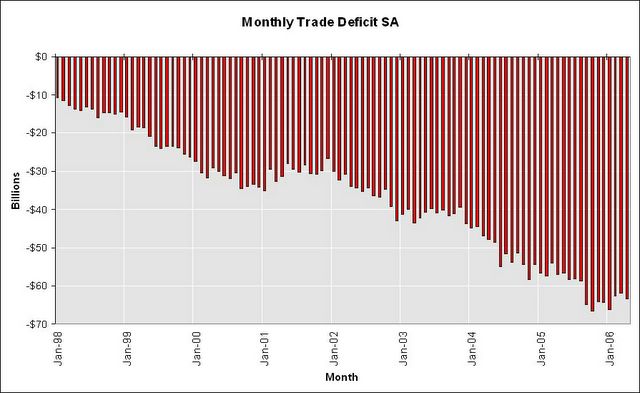
Click on graph for larger image.
Looking at a multi-year graph, its hard to say if there has been a trend change (is the deficit stabilizing at these levels?) or if the trend is still for increasing trade gaps.
My prediction for 2006 was for the deficit to stabilize at the levels seen in the 4th quarter - mostly because I thought the US economy would slow in 2006. Its still too early to tell.
See Dr. Setser's: Not quite as bad as I expected
Thursday, June 08, 2006
Household Valuation Change: FED vs. OFHEO
by Calculated Risk on 6/08/2006 10:53:00 PM
Last year I compared the change in the FED's estimate of the total value of household real estate with the OFHEO House Price Index (HPI).
The FED's estimate of the value of household real estate is in the Flow of Funds report: B.100 Balance Sheet of Households and Nonprofit Organizations. The FED includes any new stock put into place and improvements to existing stock, so we need to subtract the value of new private single family construction and improvements for the same time period.
OFHEO's House Price Index showed an increase of 2.03% for Q1 2006.
The FED's method showed an increase of 1.85%. Once again, about the same.
FED: 2006 Q1 Mortgage Debt Continues Rapid Growth
by Calculated Risk on 6/08/2006 01:46:00 PM
The FED Flow of Funds report was released today. It shows that household mortgage debt increased significantly in Q1 2006.
On a dollar basis, household mortgage debt increased by $260.7 Billion in the 1st quarter. The last 9 quarters (billions increase in household mortgages, Includes loans made under home equity lines of credit):
q1 2004: $190.4
q2 2004: $211.1
q3 2004: $277.1
q4 2004: $232.9
q1 2005: $189.9
q2 2005: $280.2
q3 2005: $314.8
q4 2005: $293.5
q1 2006: $260.7
From Reuters on debt increase: US household wealth rose in first quarter
'... the Fed said borrowing outside the financial sector soared at an annual rate of 11 percent in the first quarter, faster than the fourth quarter's 9.4 percent pace.
It was the fastest rate of growth in nonfinancial debt since an 11.9 percent rate in the fourth quarter of 1986, the Fed said.
Growth in nonfinancial debt was propelled by an annualized 12.9 percent rise in federal debt, up from a 7.8 percent increase in borrowing in the previous quarter. It was the highest rate of growth in federal debt since the first quarter of 2005.
Household borrowing gained at an 11.6 percent annual pace, up from 11.1 percent in the fourth quarter.
Business debt grew by a 10.4 percent annual rate, up from 8.3 percent at the end of 2005. Borrowing at the state and local government level slowed to a rise of 5.8 percent from 8.6 percent the previous quarter.'
Wednesday, June 07, 2006
MBA: Mortgage Refinance Applications Decline
by Calculated Risk on 6/07/2006 09:59:00 AM
The Mortgage Bankers Association (MBA) reports: Mortgage Refinance Applications Decline
Click on graph for larger image.
The Market Composite Index, a measure of mortgage loan application volume, was 534.4, a decrease of 1.4 percent on a seasonally adjusted basis from 541.9 one week earlier. On an unadjusted basis, the Index decreased 11.7 percent compared with the previous week and was down 28.0 percent compared with the same week one year earlier.Mortgage rates decreased slightly:
The seasonally-adjusted Purchase Index increased slightly to 395.6 from 395.5 the previous week whereas the Refinance Index decreased by 3.8 percent to 1356.0 from 1409.0 one week earlier...
The average contract interest rate for 30-year fixed-rate mortgages decreased to 6.60 percent from 6.66 percent ...Change in mortgage applications from one year ago (from Dow Jones):
The average contract interest rate for one-year ARMs decreased to 6.05 percent from 6.09 percent ...
| Total | -28.0% |
| Purchase | -16.9% |
| Refi | -42.6% |
| Fixed-Rate | -25.6% |
| ARM | -33.1% |
More evidence of a weak housing market in comparison to 2005.