RSS Feed
by Calculated Risk on 6/06/2006 10:50:00 AM
Tuesday, June 06, 2006
NAR: Housing Market 'Vulnerable'
Form the National Association of Realtors: Home Sales Settling Down and Appreciation Slowing
The housing boom has ended but sales at historically healthy levels will continue, and price appreciation will return to normal patterns across much of the country, according to the National Association of Realtors®.
David Lereah, NAR’s chief economist, said home sales are settling into a slower pace. “In recent years we were occasionally challenged to find appropriate superlatives to describe surprisingly high home sales,” he said. “Now the housing market has cooled, but 2006 is still expected to be the third strongest on record. In this case, experiencing a slowing from a hot market is a good thing because we need a solid housing sector to provide an underlying base to the economy, and slower appreciation will help to preserve long-term affordability. But this is a time for the Fed to pause on rate hikes because we have some interest-sensitive housing markets that have become vulnerable.”
Existing-home sales are projected to drop 6.8 percent to 6.60 million this year from the record 7.08 million in 2005. New-home sales are forecast to fall 13.4 percent to 1.11 million from a record 1.28 million in 2005. Housing starts are likely to decline 6.2 percent to 1.94 million in 2006 compared with 2.07 million last year.
NAR President Thomas M. Stevens from Vienna, Va., said rising interest rates have slowed home sales in many high cost markets, while job growth has boosted sales in some moderately priced areas. “Broadly speaking, rising inventories have taken the pressure off of unsustainable home price growth,” said Stevens, senior vice president of NRT Inc. “For most of the nation, this means future home price gains will be much closer to the normal returns we expect from housing.”
The 30-year fixed-rate mortgage should average 6.9 percent during the second half of the year, and the unemployment rate is expected to average 4.8 percent in 2006.
The national median existing-home price for all housing types is forecast to rise 5.3 percent this year to $231,300. With more construction in 2006 taking place in lower cost housing markets, the median new-home price is projected to increase 0.8 percent to $242,900.
“Historically, home prices rise 1.5 to 2 percentage points faster than the rate of inflation, so the rise we anticipate in existing home prices this year is actually a little above the high end of historic norms,” Lereah said. “The double-digit home price gains we saw in 2005 underscore what a superlative year it was.”
Inflation, as measured by the Consumer Price Index, is seen at 3.1 percent in 2006, compared with 3.4 percent last year. Growth in the U.S. gross domestic product is likely to be 3.4 percent this year. Inflation-adjusted disposable personal income should grow 3.1 percent this year.
Monday, June 05, 2006
Bernanke: Unemployment Claims Rising
by Calculated Risk on 6/05/2006 04:25:00 PM
From Bernanke's remarks today: Comments on the Outlook for the U.S. Economy and Monetary Policy
"Gains in payroll employment in recent months have been smaller than their average of the past couple of years, and initial claims for unemployment insurance have edged up. These developments are consistent with the softening in the pace of overall economic activity that seems to be under way."(emphasis added)

Click on graph for larger image.
The vertical white line is the start of the previous recession. Initial claims spiked after 9/11 and Hurricane Katrina, but in general the four week average of initial claims changes slowly.
As Bernanke noted, initial claims have been rising. A couple of weeks ago, I suggested this might be an indicator of slowing job market.
This is something to watch before the next Fed meeting.
Bernanke: Economy Slowing, Inflation Too High
by Calculated Risk on 6/05/2006 02:47:00 PM
From MarketWatch: Bernanke notes slowdown but stresses inflation fight
Although the anticipated slowdown in growth is underway, financial markets should not question the inflation-fighting credentials of the Federal Reserve, Fed chief Ben Bernanke said Monday. "There is a strong consensus" among FOMC members to keep inflation low, Bernanke told an international banking forum here. Recent core inflation readings "have been higher in recent months" and "has reached a level that, if sustained, would be at or above the upper end of the range that many economists, including myself, would consider consistent with price stability and the promotion of maximum long-run growth," Bernanke said. These core readings "are unwelcome developments," he said."Therefore, the FOMC will be vigilant to ensure that the recent pattern of elevated monthly core inflation readings is not sustained," Bernanke said. Bernanke said the slow down in the U.S. economy is no longer simply a forecast. "Real domestic product grew rapidly in the first quarter of this year, but the anticipated moderation of economic growth seems now to be under way," Greenspan said.I enjoyed the Greenspan error in the last sentence! This should impact the Fed Funds expectations again.
Expectations of a FED Pause Rise
by Calculated Risk on 6/05/2006 10:49:00 AM
From the Cleveland FED: Fed Funds Rate Predictions
Click on graph for larger image.
After the jobs report on Friday, market expectations are split almost evenly between a pause and one more 25 bps hike.
These are the same graphs that Dr. Altig used to present Monday (See Dr. Altig: Hawk Killer). Now the Cleveland Fed is updating these graphs daily.

Saturday, June 03, 2006
UCLA's Leamer: Housing a "Sick Sector"
by Calculated Risk on 6/03/2006 08:54:00 AM
From Lisa Girion at the LA Times: Weak Job Growth Raises Concerns
UCLA Anderson Forecast Director Edward Leamer said all the speculation about what the central bank and its new chairman, Ben S. Bernanke, should do about rates was folly because of a real estate slowdown that was well underway.A few more comments on the economy from the article:
"I don't think the Fed, at this point, has much control," Leamer said.
"We have a sick sector, the housing sector, and there's not a whole lot of medicine the Fed can provide."
Leamer's group sees declining home sales contributing to a broad economic slowdown that bottoms out at 2% growth and stays there for at least a couple of years.
"It's been a drunken party for several years," he said. "Now, we have to deal with the hangover."
"The slowdown is in place," wrote John Silvia, an economist at Wachovia Corp. "How much and how rapid remains an issue."
"There is now a growing body of evidence — especially among leading indicators — that a meaningful economic slowdown is underway and this will finally cause the Fed to hold" its benchmark short-term rate at 5%, said Bernard Baumohl, executive director of Economic Outlook Group.
"The economy is slowing fast," said Ian Shepherdson, chief U.S. economist at High Frequency Economics Ltd.
Friday, June 02, 2006
Standard Pacific Corp. Warns
by Calculated Risk on 6/02/2006 07:38:00 PM
Yawn ... another homebuilder warns: Standard Pacific Corp.
Net new home orders for the first two months of the 2006 second quarter were down 41% from the year earlier period, driven in large part by an increase in the Company's cancellation rate and continued softening of demand in many of the Company's larger markets. Orders were off in Southern California, Northern California, Florida and Arizona, up in Texas and Colorado and off slightly in the Carolinas. The Company's gross orders for the first two months of the 2006 second quarter were off 22% versus the year ago period.
In light of the decreased order levels for the first two months of the 2006 second quarter, the Company expects to lower its earnings and delivery guidance for the full year and will provide the updated guidance in conjunction with its regularly scheduled earnings release at the end of July.
Pulte Homes Warns
by Calculated Risk on 6/02/2006 05:35:00 PM
There are some interesting comments in this Reuters report: Pulte Homes cuts outlook on cooling housing market
Pulte Homes Inc. [No. 2 U.S. home builder] on Friday slashed its second-quarter and full-year profit outlook ...Blame the messenger is apparently wrong; a new survey today showed most homeowners are still optimistic about the housing market:
"There's a lot of inventory and the market's slowing," said Thomas Leritz, Argent Capital Management portfolio manager ... "Consumer sentiment is negative on housing," he added. "Every day you look at the newspaper, you read a magazine or watch TV, you see some comment about how the housing market is a bubble. People are scared."
...
Analysts expect the current quarter's results for home builders will be much weaker than last year's, when the U.S. housing boom peaked.
Despite signs of a real estate slowdown, American homeowners aren’t expecting a steep drop in the value of their properties, according to a survey released today by ING Direct...
• Nearly three-quarters of ... homeowners surveyed ... weren’t worried that there will be a downturn in the housing market ... Homeowners, on average, are anticipating a 4 percent increase in the value of their homes over the next 12 months...
House Price Index: Effect of Appraisal Data
by Calculated Risk on 6/02/2006 03:43:00 PM
Reader ac suggests in the comments:
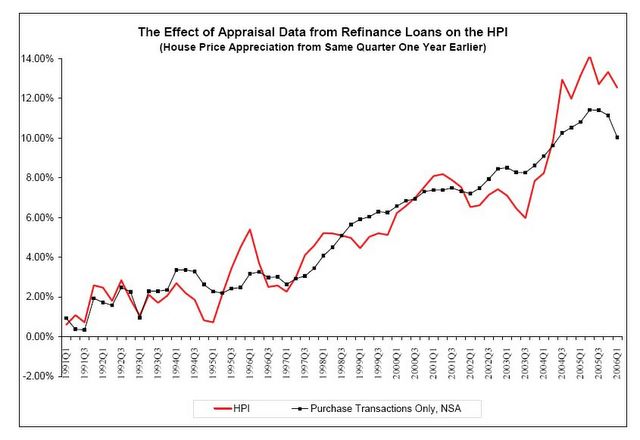
"[Could you] post an image of the graph (The Effect of Appraisal Data from Refinance Loans on the HPI) from page 4 of the 2006 Q1 OFHEO HPI data on your site?Here is the graph from the OFHEO HPI:
Seems like there's a lot of misinterpretation and misuse of the HPI data showing up in some media reports... an image of that graph might help with "educating" people.
I think it's clear now that the Q1 HPI numbers were pumped up by appraisals which apparently lag actual sales prices."
Click on graph for larger image.
From OFHEO:
"An important factor that has affected the HPI in some recent quarters is the influence of refinancings on the overall index. The figure below shows percent changes in the HPI for the United States as a whole over the prior four quarters compared with changes in an index constructed using only house prices associated with mortgages used for house purchases. The upward trend is the same, but the purchase-only index has accelerated much more smoothly. Over the past year, while the U.S. HPI has risen 12.54 percent, the purchase-only index has risen 10.04 percent."
And from the OC Register:
The report showed that Orange County home values increased by 2.95 percent in the first quarter of 2006 ... But numbers from other sources place Orange County's appreciation rate at much lower levels...As ac suggests, the HPI appears to be overstating appreciation in the most recent quarters due to the impact of cash-out refis.
Officials compiling the federal index agree their numbers may be overly optimistic. They cited a growing incidence of homeowners extracting cash from loans against their homes' increased value. That's something that may occur more often in homes that have appreciated the most, the agency said.
"Evidence suggests that the growing prevalence of cash-out refinances over the last year has had the effect of increasing measured appreciation rates for the HPI," the [OFHEO] said.
emphasis added.
Employment Report
by Calculated Risk on 6/02/2006 12:24:00 PM
Click on graph for larger image.
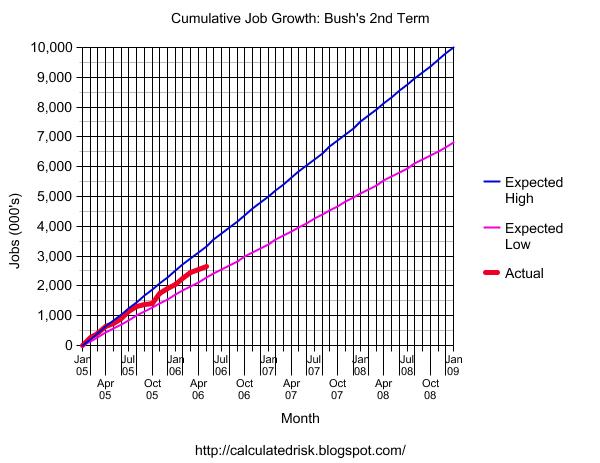
This graph shows employment growth for Bush's second term. So far job growth has been about as expected.
Kash has more: Employment Update
"Those who were employed actually worked fewer hours in May, and nominal earnings were stagnant after rising at a reasonable pace for the past several months (this means that real earnings fell, of course). All in all, this is a pretty lousy jobs report.And from Barry Ritholtz: NFP stinks -- and Some People Still Don't Get It
Does this provide evidence of a slowing economy? We'll need a few more months of weak job readings to tell for sure, but it's definitely starting to look like a real possibility."
"As unemployment starts ticking up, it will not be pretty. It suggests the next recession will be more severe than the last one."From Brad DeLong: A Non-High Pressure Labor Market
"Three percent productivity growth. Zero percent real wage growth. Not an economy near full employment feeling rising inflationary pressures from labor."
Housing: IRS Raps DAPs
by Calculated Risk on 6/02/2006 02:11:00 AM
Last year I wrote about the proliferation of DAPs (Downpayment Assistance Programs). Now the IRS has ruled that these are "scams".
From the WaPo: IRS Ruling Imperils 'Gift Fund' Charities For Home Buyers
A ruling by the Internal Revenue Service threatens to extinguish a fast-growing -- but controversial -- charitable industry that has funneled hundreds of millions of dollars in cash to first-time home buyers for their down payments.Lets do the math: If $500 Million is 3% of the purchase price, then this represented downpayments on about $16 Billion in transactions last year. OK, about 7 million existing homes were sold in 2005 at an average price of around $270K. So less than 1% of the total value of transactions last year used DAPs (even less when we add in New Homes) - but these are still marginal deals.
...
Under the system, sellers provide cash to the charities, which then give it to home buyers for their down payments. The sellers, who pay the charities a service fee, often recoup their money by charging a higher price for the homes -- usually 2 or 3 percent more, or an amount equal to the down payment, says a Government Accountability Office study.
...
The IRS called the programs "scams" in its ruling last month and said that by providing down payments, the charities actually inflated home prices, making it more likely that homeowners would default on their loans.
...
The charities say they move $500 million a year from sellers to buyers -- money that would disappear if many down payment assistance charities were put out of business.
"Almost anybody building for the first-time home buyer is using these programs," said David Ledford, staff vice president for housing finance and housing policy with the National Association of Home Builders. "Builders are concerned about what would happen not just in the future but for buyers who have already qualified and are going through a sale but who have not closed yet."