
 RSS Feed
 by Calculated Risk on 8/30/2005 04:04:00 PM
Tuesday, August 30, 2005
The Economist: Katrina Could Tip US / World into Recession
The Economist ponders the impact of Katrina: The damage that Katrina could still wreak:
Besides its devastating cost in lives, Katrina could push the American economy—maybe even the world economy—into recession ...
Nor will the effects of Hurricane Katrina be limited to the Gulf Coast and the offices of a few agitated insurers. Analysts are busy rewriting their forecasts of America’s fourth-quarter GDP growth to take into account the expected economic repercussions of the devastation. The affected area’s ports move a large fraction of the nation’s imports—including critical oil and gas supplies—as well as roughly half its exports of agricultural commodities like corn and soyabeans. ...
Chief among the worries is the oil industry. The Gulf of Mexico provides about a tenth of all the crude oil consumed in America; and almost half of the petrol produced in the country comes from refineries in the states along the gulf's shores. Oil companies are busy assessing how much damage was done to drilling rigs, refineries and port facilities ... This is bad news considering that refineries have been running flat out in recent months to keep up with high demand. ... while much of the recent oil-price increase was demand-driven, and thus expected to have relatively benign economic effects, any outages owing to Katrina could cause a supply shock—meaning the kind of sudden, negative effects that battered the world economy in the 1970s.
As a rule of thumb, every $10 sustained increase in the price of a barrel of oil is estimated to result in a loss of something like half a percentage point of GDP. ... Some economists are worried that if there are extensive shutdowns of oil and gas production, this could push the economy to the brink of recession.
That is bad news abroad ... particularly ... Asia ... are already dangerously dependent on robust American demand for their exports. Those countries are also being hit by higher oil prices. Indonesia’s central bank was forced to tighten the money supply sharply on Tuesday ... While rich countries are much less dependent on oil than they used to be, thanks to increases in fuel efficiency and a shift from manufacturing to services, middle-income countries are still big energy guzzlers: India and South Korea use more oil per dollar of GDP today than they did in the 1970s.
Europe’s recovery could also be choked off in its infancy by the steady upward march of prices for petrol and heating oil. That would weaken another of Asian exporters’ main markets and leave the global economy little refuge if American demand were to stutter. If Katrina has damaged America’s capacity to pump and refine oil, forcing Americans to shop abroad for more fuel to feed their gluttonous appetites, it could be a long cold winter for everyone.
Monday, August 29, 2005
Katrina: Refinery Map
by Calculated Risk on 8/29/2005 11:46:00 PM
UPDATE3: Chevron says won't know full storm damage until Wednesday SAN FRANCISCO (AFX) --
Chevron Corp. said Tuesday it will not know the extent of hurricane damage to its Gulf of Mexico oil and gas facilities until Wednesday. A Houston-based spokesman for the nation's second-biggest oil company said their aircraft were currently making initial damage assessments of offshore rigs and onshore facilities, including the 325,000 barrel-per-day Pascagoula refinery in Mississippi, which the company evacuated ahead of Katrina. Pascagoula is one of the biggest refineries along the Gulf Coast. Chevron evacuated 2,100 offshore employees and contract workers and shut its New Orleans office ahead of the hurricane. The company declined to say how much oil and gas output was shut by the stormUpdate: Here is a much better map. Thanks to Dr. Hamilton. (My Original Map removed)
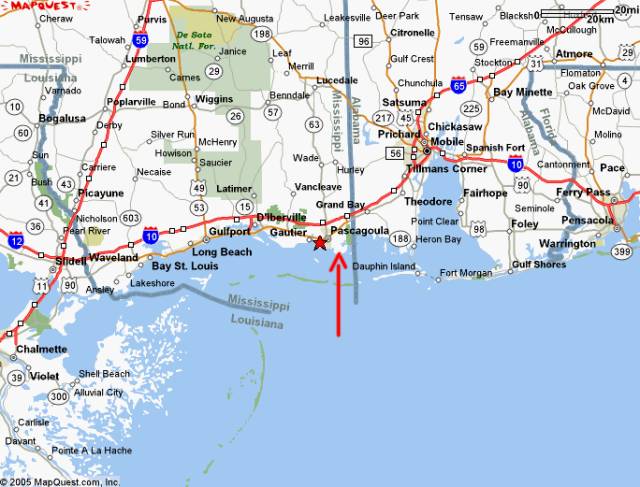
Click on graph for larger image.
This map shows the location (arrow) of Chevron's Pascagoula facility. This is not on the Louisiana only map linked above.
UPDATE: "Exxon Mobil Refining & Supply Co.'s Baton Rouge, La. refinery - had not been affected by the storm or had resumed normal operations by late Monday."
| Number | Facility | Production 1000s bbl/day |
| 1 | Valero's St. Charles | 260 |
| 2 | Exxon Mobil Corp.'s Baton Rouge | 494 |
| 3 | Motiva's Convent | 255 |
| 3 | Motiva's Norco | 242 |
| 3 | Marathon's Garyville | 245 |
| 4 | ConocoPhillips' Belle Chasse | 247 |
| 4 | Murphy Oil Corp.'s Meraux | 125 |
| 4 | Chalmette Refining | 187 |
| 5 | Chevron's Pascagoula | 325 |
SOURCE.
Valero is the only facility to report:
Valero sees re-opening refinery in Louisiana in 1-2 weeks (VLO) By Carla Mozee
SAN FRANCISCO (MarketWatch) -- Valero Energy Corp. (VLO) said Monday evening that it expects to re-open its St. Charles refinery in Louisiana in one to two weeks. The company said that the refinery is now without power and that it may take two to three days for it to return. It also said that there is 3 feet of flood water in two units and that it may have to repair pumps, electric motors and electrical switchgear. Valero also sees minor damage to its cooling towers. The company said that no major damage is apparent and there's no evidence of spills or leaks.
Katrina: Oil and Gas
by Calculated Risk on 8/29/2005 06:57:00 PM
Luckily hurricane Katrina weakened before it came onshore and the "worst case" scenario was avoided, however there still appears to be severe damage and widespread devastation. My thoughts are with the victims of this massive storm.
Early estimates are that Katrina will be one of the most expensive hurricanes to ever hit the US. Although the damage is major, the economic impact on the United States will be from any significant damage to the oil infrastructure on the Gulf Coast. It will take some time to assess the damage to refineries, and oil and gas production facilities. We are starting to see stories like this:
Valero sees re-opening refinery in Louisiana in 1-2 weeks (VLO) By Carla MozeeAnd some good news on Natural Gas: Henry Hub reopens for delivery
SAN FRANCISCO (MarketWatch) -- Valero Energy Corp. (VLO) said Monday evening that it expects to re-open its St. Charles refinery in Louisiana in one to two weeks. The company said that the refinery is now without power and that it may take two to three days for it to return. It also said that there is 3 feet of flood water in two units and that it may have to repair pumps, electric motors and electrical switchgear. Valero also sees minor damage to its cooling towers. The company said that no major damage is apparent and there's no evidence of spills or leaks.
A potential crisis in the natural-gas markets was apparently averted Monday after the company operating the Henry Hub gas gathering facility said it avoided major damage from Hurricane Katrina and reopened the site for delivery and receipt.But a couple of cautionary comments from this story:
"After Ivan hit, the initial word was that it wasn't that bad." [said Bob Slaughter, president of the National Petrochemical and Refiners Association].
"Our goal is to get back up as soon as possible, but do it safely. It took almost a year to get back up to full production after Hurricane Ivan," [said Tony Lentini, spokesman for Apache Corp].Oil, natural gas and gasoline futures all soared as Katrina appeared to be the storm of the century, and settled back when the damage was less severe than initially feared. Still, from Friday's closing prices, oil is up 2%, gasoline 8% and Natural Gas 18%. On Friday, I pointed out that oil inventories were solid (see Dr. Hamilton's Supply factors in the 2005 oil price surge), but gasoline stocks were tight.

Click on graph for larger image.
This graph is from the DOE.
We will not know the extent of the damage to refineries for several days, but the US can expect a price spike at the pumps on top of already record gasoline prices. One prediction:
"One analyst said pump prices nationwide would likely average more than $2.75 a gallon by week's end — up from $2.61 a gallon last week"
 Meanwhile crude stocks are robust and well above the average range. Plus the White House has suggested that oil could be released from the Strategic Petroleum Reserve if needed.
It is difficult to make any predictions, especially with stories of oil rigs adrift. But with above average oil stocks, it appears there will be no short term crude oil supply issues.
Gasoline is a different story. And there might be concerns about adequate heating oil supplies too.
Krugman: Greenspan and the Bubble
by Calculated Risk on 8/29/2005 01:54:00 AM
Dr. Krugman writes in the NY Times about Greenspan and the Bubble:
At the conference, Mr. Greenspan didn't say in plain English that house prices are way out of line .... What he did say ... that "history has not dealt kindly with the aftermath of protracted periods of low-risk premiums." I believe that translates as "Beware the bursting bubble."Then Dr. Krugman asks the question we've all been asking: How bad will it be?
But as recently as last October Mr. Greenspan dismissed talk of a housing bubble: "While local economies may experience significant speculative price imbalances, a national severe price distortion seems most unlikely."
Wait, it gets worse. These days Mr. Greenspan expresses concern about the financial risks created by "the prevalence of interest-only loans and the introduction of more-exotic forms of adjustable-rate mortgages." But last year he encouraged families to take on those very risks ...
The U.S. economy is currently suffering from twin imbalances. ... domestic spending is swollen by the housing bubble, which has led both to a huge surge in construction and to high consumer spending, as people extract equity from their homes. On the other side, we have a huge trade deficit ...
One way or another, the economy will eventually eliminate both imbalances. But if the process doesn't go smoothly - if, in particular, the housing bubble bursts before the trade deficit shrinks - we're going to have an economic slowdown, and possibly a recession. ...
A housing slowdown will lead to the loss of many jobs in construction and service industries but won't have much direct effect on the trade deficit. So those jobs won't be replaced by new jobs elsewhere until and unless something else, like a plunge in the value of the dollar, makes U.S. goods more competitive on world markets, leading to higher exports and lower imports.
So there's a rough ride ahead for the U.S. economy ....
Angry Bear: Housing and Recession
by Calculated Risk on 8/29/2005 12:14:00 AM
My most recent post is up on Angry Bear: Housing and Recession
Every time I sat down at my computer today, I found myself checking on hurricane Katrina. I am in shock. The residents of New Orleans are in my thoughts tonight. A couple of days ago I thought this storm might impact the already tight gasoline supplies, but I didn't think it would become a potentially catastrophic storm.
Hopefully the storm will weaken before landfall.
Best to all.
Sunday, August 28, 2005
Borrowing and Bankruptcy
by Calculated Risk on 8/28/2005 09:22:00 AM
The LA Times has two related articles this morning on borrowing and bankruptcy. From "Equity Is Altering Spending Habits and View of Debt":
People are cashing out so quickly that the term "homeowner" may soon be inaccurate. Fifty years ago, Americans owned, on average, three-quarters of their house and the lender owned the rest. These days, it's approaching an even split.This is behavior is being encouraged by industry "experts":
This spend-now-rather-than-save-for-later phenomenon has produced undeniable benefits. Experts attribute much of the nation's economic growth to cash-out refinancings, home equity loans and other methods of tapping rising home values.
"If you paid your mortgage off, it means you probably did not manage your funds efficiently over the years," said David Lereah, chief economist of the National Association of Realtors and author of "Are You Missing the Real Estate Boom?" "It's as if you had 500,000 dollar bills stuffed in your mattress."The entire article is fascinating, but this anecdote shows poor financial planning:
He called it "very unsophisticated."
Anthony Hsieh, chief executive of LendingTree Loans, an Internet-based mortgage company, used a more disparaging term. "If you own your own home free and clear, people will often refer to you as a fool. All that money sitting there, doing nothing."
The financial services industry is doing all it can to avoid letting consumers be foolish. Ditech.com touts home loans as a way to pay off credit cards, and Morgan Stanley says they're a good way to fund education expenses. Wells Fargo suggests taking a chunk out of your house to finance "a dream wedding."
He bought his condo in expensive Marin County, north of San Francisco, for $510,000 in April 2004. The bank offered to finance the whole thing, but he decided to be a little conservative and put 5% down.Although money is fungible, paying for short term assets with long term debt is poor financial planning. Imagine going to a fast food restaurant and buying a hamburger on your credit card. Then you borrow money against your house to pay off your credit card debt. Now you are financing lunch for 30 years!
By January, the condo was worth $555,000, and Levy refinanced. He took out $25,000 in cash, less than the bank offered to give him. The money paid off what he describes as "really ugly" credit card debt.
The interest rate on the credit card had been more than double the rate on his mortgage, so he saved about $600 a month. Furthermore, his mortgage interest is tax-deductible; his credit card interest was not.
"It used to be that all debt was created equal and all debt was evil," Levy said. "But the tax breaks alone make a pretty compelling case to use home equity to finance just about everything."
The other article in the LA Times, "A fresh calamity?", fits nicely with the first.
Under the new bankruptcy regulations, homeowners will no longer necessarily be able to hand the keys to the bank and move on. Lenders will, in many cases, have the option of coming after them for virtually everything else they've got -- income, money in bank accounts and other assets.For homeowners that are heavily in debt, and have refinanced or used a HELOC (Home Equity Line of Credit), this might be their future.
Homeowners who have refinanced may have unwittingly put themselves at the greatest risk. State regulations will still offer financial protections for buyers who have their original mortgages.
"There is no doubt this law will make it harder for some people to walk away," said Gary Painter, a professor at the USC School of Policy, Planning and Development. "It definitely could hurt homeowners."
I wonder who is going to look "foolish" and "unsophisticated" in the coming years.
Saturday, August 27, 2005
Greenspan: Closing Remarks
by Calculated Risk on 8/27/2005 06:38:00 PM
From FED Chairman Alan Greenspan's closing remarks at Jackson Hole, Wyoming:
"... the housing boom will inevitably simmer down. As part of that process, house turnover will decline from currently historic levels, while home price increases will slow and prices could even decrease. As a consequence, home equity extraction will ease and with it some of the strength in personal consumption expenditures. The estimates of how much differ widely."Emphasis added. I believe prices will decrease. And the following, on the relationship between home equity extraction and the currenct account (mostly trade) deficit, is important in how the imbalances will unwind:
"The surprisingly high correlation between increases in home equity extraction and the current account deficit suggests that an end to the housing boom could induce a significant rise in the personal saving rate, a decline in imports, and a corresponding improvement in the current account deficit."And part of Greenspan's conclusion is a little scary:
"Surely difficult challenges lie ahead for the Fed, some undoubtedly of our own making, and others that will be thrust on us by market or other forces."
Gasoline: Demand Strong, Inventories Drop
by Calculated Risk on 8/27/2005 12:03:00 AM
Gasoline stocks have continued to drop and are now near the bottom of the normal range.
Click on graph for larger image.
This graph is from the DOE.
It is possible that we might see a regional spike in gasoline prices unrelated to the price of oil. With possible major hurricane Katrina bearing down on the gulf coast, a drop in the already tight supply might occur.
The National Hurricane Center provides frequent updates on tropical storms. Although the exact location of landfall and intensity are difficult to predict, it appears Katrina will pass over extremely warm waters and make landfall in the Gulf Coast late Monday. This could disrupt several refineries including the 300,000 barrel-a-day Chevron Pascagoula, Mississippi facility.
Meanwhile demand for gasoline has remained strong.
This graph shows the Year over Year % increase in demand for:
1) Year to date.
2) Last 8 weeks compared to similar period last year.
3) Last 4 weeks compared to similar period last year.
(SOURCE: DOE)
Year to date demand for gasoline remains strong. For the shorter periods there is some normal variability, but there is no clear evidence of weakening demand for either period: the last 8 weeks and the last 4 weeks compared to 2004.
This is an update to an earlier post that discusses how the US economy has become more dependent on oil for transportation purposes as opposed to other uses of petroleum.
Friday, August 26, 2005
Dr. Leamer: Housing Has Peaked, Recession in '06
by Calculated Risk on 8/26/2005 05:20:00 PM
From an interview with FoxNews, Dr. Leamer Director of UCLA Anderson Forecast:
... the housing market appears to have peaked "in California and elsewhere. It will take more than a year for this weakness to turn into job losses and to affect the economy in general.Dr. Leamer believes the housing slow down will lead to a recession and will be felt everywhere:
And contrary to what a lot of so-called "experts" are predicting, Leamer, believes the pain will be felt on a national level, not just locally. As an economist he’s much more concerned about the broader implications of a slowdown in the housing market than about the price bubbles some areas are experiencing.And its not just housing - Dr. Leamer is concerned about the auto industry too:
"We’ve had ten economic downturns since World War II and eight of them started in the housing sector. It’s the first component of gross domestic product that starts to weaken," says Leamer. He keeps a close eye on what consumers spend on housing because it has a ripple effect, pointing out that a decline will lead to layoffs in construction, banking, and the real estate industry, to name just a few areas.
Leamer lays the blame squarely on the Federal Reserve for leaving interest rates too low for too long. Now, he says, we’re not only heading for trouble in the housing sector, but in the auto industry — another market that got drunk on historically low rates.Leamer's advice:
Low borrowing costs accelerated future sales by enticing consumers to trade up to bigger homes and new vehicles sooner than they might have done otherwise. ... As a result, car dealers lose the sale they would have gotten two years from now.
As rates creep higher, consumers happily driving their new cars or living in their larger homes have no motivation to purchase additional ones. Since consumer spending drives two-thirds of our economy, when consumers close their wallets, the impact is far-reaching.
While the real estate bubble itself may be all about "location, location, location," in Leamer’s view the coming housing slowdown will have national implications, although areas that have benefited most from the housing boom are likely to be hit hardest. For example, Southern California, where Leamer lives. He says the strong housing market "created a lot of jobs — in construction, in banking, in real estate. If that disappears, a basic driver for the local economy disappears." ...
If you’ve been shopping for a home, Leamer says you "need to recognize the risk and do some hard-nosed thinking" ... he suggests you add up all the monthly costs and benefits (such as tax deductions) of owning versus renting. If buying still makes sense, his advice is: "Think long term — seven to 10 years. Avoid adjustable rate mortgages. Lock in a low, fixed interest rate." ... "If you’re not sure you’re going to be living in the home in two to three years, don’t buy it."
Dr. Duy: More Rate Hikes
by Calculated Risk on 8/26/2005 03:33:00 PM
Dr. Duy discusses a wide variety of topics in today's Fed Watch. Dr. Duy thinks it is very likely that the FED Funds rate will reach 4.25% by the December FOMC meeting:
"... I see the calendar as supportive of another 75bp this year - which will come close to cutting the yield curve to zero unless long term rates start to move - and I see no indications from Fed officials to tell me that this story is wildly wrong."And Duy cautions that the markets may not be prepared:
"... one has to wonder if financial market participants are not entirely convinced that the Fed will continue to raise rates and narrow the spread, or, if the Fed did so to the detriment of the economy, it would quickly reverse course to support financial markets - the "Greenspan put." To me, the latter is not a given this time, especially in an environment of rising energy prices."Duy concludes:
"... regardless of the possibility of a recession in 2006, I still see the Fed as laying the groundwork for continued monetary tightening, even as they see the possibility that financial markets are not entirely prepared for that outcome."As usual, a very insightful look at the Fed's World View.
Dr. Duy's post: Fed Watch: Forecast Calls For More Rate Hikes




