
 RSS Feed
 by Calculated Risk on 8/27/2005 06:38:00 PM
Saturday, August 27, 2005
Greenspan: Closing Remarks
From FED Chairman Alan Greenspan's closing remarks at Jackson Hole, Wyoming:
"... the housing boom will inevitably simmer down. As part of that process, house turnover will decline from currently historic levels, while home price increases will slow and prices could even decrease. As a consequence, home equity extraction will ease and with it some of the strength in personal consumption expenditures. The estimates of how much differ widely."Emphasis added. I believe prices will decrease. And the following, on the relationship between home equity extraction and the currenct account (mostly trade) deficit, is important in how the imbalances will unwind:
"The surprisingly high correlation between increases in home equity extraction and the current account deficit suggests that an end to the housing boom could induce a significant rise in the personal saving rate, a decline in imports, and a corresponding improvement in the current account deficit."And part of Greenspan's conclusion is a little scary:
"Surely difficult challenges lie ahead for the Fed, some undoubtedly of our own making, and others that will be thrust on us by market or other forces."
Gasoline: Demand Strong, Inventories Drop
by Calculated Risk on 8/27/2005 12:03:00 AM
Gasoline stocks have continued to drop and are now near the bottom of the normal range.
Click on graph for larger image.
This graph is from the DOE.
It is possible that we might see a regional spike in gasoline prices unrelated to the price of oil. With possible major hurricane Katrina bearing down on the gulf coast, a drop in the already tight supply might occur.
The National Hurricane Center provides frequent updates on tropical storms. Although the exact location of landfall and intensity are difficult to predict, it appears Katrina will pass over extremely warm waters and make landfall in the Gulf Coast late Monday. This could disrupt several refineries including the 300,000 barrel-a-day Chevron Pascagoula, Mississippi facility.
Meanwhile demand for gasoline has remained strong.
This graph shows the Year over Year % increase in demand for:
1) Year to date.
2) Last 8 weeks compared to similar period last year.
3) Last 4 weeks compared to similar period last year.
(SOURCE: DOE)
Year to date demand for gasoline remains strong. For the shorter periods there is some normal variability, but there is no clear evidence of weakening demand for either period: the last 8 weeks and the last 4 weeks compared to 2004.
This is an update to an earlier post that discusses how the US economy has become more dependent on oil for transportation purposes as opposed to other uses of petroleum.
Friday, August 26, 2005
Dr. Leamer: Housing Has Peaked, Recession in '06
by Calculated Risk on 8/26/2005 05:20:00 PM
From an interview with FoxNews, Dr. Leamer Director of UCLA Anderson Forecast:
... the housing market appears to have peaked "in California and elsewhere. It will take more than a year for this weakness to turn into job losses and to affect the economy in general.Dr. Leamer believes the housing slow down will lead to a recession and will be felt everywhere:
And contrary to what a lot of so-called "experts" are predicting, Leamer, believes the pain will be felt on a national level, not just locally. As an economist he’s much more concerned about the broader implications of a slowdown in the housing market than about the price bubbles some areas are experiencing.And its not just housing - Dr. Leamer is concerned about the auto industry too:
"We’ve had ten economic downturns since World War II and eight of them started in the housing sector. It’s the first component of gross domestic product that starts to weaken," says Leamer. He keeps a close eye on what consumers spend on housing because it has a ripple effect, pointing out that a decline will lead to layoffs in construction, banking, and the real estate industry, to name just a few areas.
Leamer lays the blame squarely on the Federal Reserve for leaving interest rates too low for too long. Now, he says, we’re not only heading for trouble in the housing sector, but in the auto industry — another market that got drunk on historically low rates.Leamer's advice:
Low borrowing costs accelerated future sales by enticing consumers to trade up to bigger homes and new vehicles sooner than they might have done otherwise. ... As a result, car dealers lose the sale they would have gotten two years from now.
As rates creep higher, consumers happily driving their new cars or living in their larger homes have no motivation to purchase additional ones. Since consumer spending drives two-thirds of our economy, when consumers close their wallets, the impact is far-reaching.
While the real estate bubble itself may be all about "location, location, location," in Leamer’s view the coming housing slowdown will have national implications, although areas that have benefited most from the housing boom are likely to be hit hardest. For example, Southern California, where Leamer lives. He says the strong housing market "created a lot of jobs — in construction, in banking, in real estate. If that disappears, a basic driver for the local economy disappears." ...
If you’ve been shopping for a home, Leamer says you "need to recognize the risk and do some hard-nosed thinking" ... he suggests you add up all the monthly costs and benefits (such as tax deductions) of owning versus renting. If buying still makes sense, his advice is: "Think long term — seven to 10 years. Avoid adjustable rate mortgages. Lock in a low, fixed interest rate." ... "If you’re not sure you’re going to be living in the home in two to three years, don’t buy it."
Dr. Duy: More Rate Hikes
by Calculated Risk on 8/26/2005 03:33:00 PM
Dr. Duy discusses a wide variety of topics in today's Fed Watch. Dr. Duy thinks it is very likely that the FED Funds rate will reach 4.25% by the December FOMC meeting:
"... I see the calendar as supportive of another 75bp this year - which will come close to cutting the yield curve to zero unless long term rates start to move - and I see no indications from Fed officials to tell me that this story is wildly wrong."And Duy cautions that the markets may not be prepared:
"... one has to wonder if financial market participants are not entirely convinced that the Fed will continue to raise rates and narrow the spread, or, if the Fed did so to the detriment of the economy, it would quickly reverse course to support financial markets - the "Greenspan put." To me, the latter is not a given this time, especially in an environment of rising energy prices."Duy concludes:
"... regardless of the possibility of a recession in 2006, I still see the Fed as laying the groundwork for continued monetary tightening, even as they see the possibility that financial markets are not entirely prepared for that outcome."As usual, a very insightful look at the Fed's World View.
Dr. Duy's post: Fed Watch: Forecast Calls For More Rate Hikes
Greenspan on the Asset Economy
by Calculated Risk on 8/26/2005 11:02:00 AM
Greenspan spoke this morning at Jackson Hole, Wyoming. This weekend will see many stories on Chairman Greenspan, but here are a few relevant comments (My emphasis added):
The structure of our economy will doubtless change in the years ahead. In particular, our analysis of economic developments almost surely will need to deal in greater detail with balance sheet considerations than was the case in the earlier decades of the postwar period. The determination of global economic activity in recent years has been influenced importantly by capital gains on various types of assets, and the liabilities that finance them. Our forecasts and hence policy are becoming increasingly driven by asset price changes.
The steep rise in the ratio of household net worth to disposable income in the mid-1990s, after a half-century of stability, is a case in point. Although the ratio fell with the collapse of equity prices in 2000, it has rebounded noticeably over the past couple of years, reflecting the rise in the prices of equities and houses.
Whether the currently elevated level of the wealth-to-income ratio will be sustained in the longer run remains to be seen. But arguably, the growing stability of the world economy over the past decade may have encouraged investors to accept increasingly lower levels of compensation for risk. They are exhibiting a seeming willingness to project stability and commit over an ever more extended time horizon.
The lowered risk premiums--the apparent consequence of a long period of economic stability--coupled with greater productivity growth have propelled asset prices higher. The rising prices of stocks, bonds and, more recently, of homes, have engendered a large increase in the market value of claims which, when converted to cash, are a source of purchasing power. Financial intermediaries, of course, routinely convert capital gains in stocks, bonds, and homes into cash for businesses and households to facilitate purchase transactions. The conversions have been markedly facilitated by the financial innovation that has greatly reduced the cost of such transactions.
Thus, this vast increase in the market value of asset claims is in part the indirect result of investors accepting lower compensation for risk. Such an increase in market value is too often viewed by market participants as structural and permanent. To some extent, those higher values may be reflecting the increased flexibility and resilience of our economy. But what they perceive as newly abundant liquidity can readily disappear. Any onset of increased investor caution elevates risk premiums and, as a consequence, lowers asset values and promotes the liquidation of the debt that supported higher prices. This is the reason that history has not dealt kindly with the aftermath of protracted periods of low risk premiums.
Bill Maher: "But don't let me burst your bubble"
by Calculated Risk on 8/26/2005 01:03:00 AM
Bill Maher writes in the LA Times: But don't let me burst your bubble
You don't have to remember history, but you do have to remember Thursday. The bursting of the Nasdaq bubble was only five years ago. People lost a trillion dollars. And here we are today with real estate prices across the country that could aptly be compared to Courtney Love: irrationally high and about to collapse.Enjoy!
I don't want to say there's a housing bubble, but I had a refrigerator delivered this morning and a homeless guy offered me $3 million for the box. Not to burst your bubble, but all bubbles do burst. And we learned this recently. It's not just that grandma was alive the last time it happened. You were alive. Eminem was on the radio. Just like now because, again, it wasn't that long ago.
Thursday, August 25, 2005
Floyd Norris: "The real key to a housing bubble"
by Calculated Risk on 8/25/2005 06:52:00 PM
Floyd Norris, chief financial correspondent of The New York Times, has an interesting take on the housing market:
If housing prices fall, will mortgages cushion the downfall, or make it worse? Put another way, will more overstretched homeowners be forced to sell?Mr. Norris reviews previous housing slowdowns and contrasts housing, bought with mortgages, to stock, bought on margin. I recommend reading his comments.
At issue is whether financial innovations that have made it easier for Americans to buy homes have also made the system less stable and more vulnerable to shocks that could drive many of them from their homes, having lost all they invested in them.
The interesting and somewhat novel observation is that Mr. Norris believes we can tell, when housing starts to slow down, if it is an ordinary housing slowdown or a possible disaster by whether or not transaction volumes decline significantly for existing home sales.
But if and when a fall comes, watch the volume of home sales, particularly of existing homes. Back in 1978, almost four million sales of such homes were counted by the National Association of Realtors. By 1982, amid recession and rising interest rates, the figure was under two million.I've been expecting volumes to drop significantly (what Mr. Norris suggests is normal). Of course the "limited damage" would be a slow down in GDP growth or a mild recession.
...
If [then number of transactions] falls rapidly, that will be an indication that not much has changed, and the damage is likely to be limited.
But if sales volume stays high, that could indicate that the mortgage innovations are hurting. Then we could see rising numbers of foreclosures as homeowners discover they cannot sell their homes for what they owe but also cannot pay their suddenly higher monthly mortgage bills.
If volumes stay high while prices drop, Mr. Norris argues we are in for tough times.
Krugman: Housing Bubble will Burst
by Calculated Risk on 8/25/2005 02:46:00 PM
Reuters quotes Dr. Krugman:
"I'll give you a forecast which might very well be wrong, but I think it will burst in the spring of next year," he said at a derivatives conference in Brazil's winter resort of Campos do Jordao.I think it will be sooner rather than later.
"I would be surprised if it doesn't burst in the next three years," he added.
Krugman said skyrocketing U.S. housing prices were supported by large -- and somewhat "odd" -- capital inflows from emerging market countries, such as China, which has accumulated huge holdings of U.S. Treasury debt, helping keep long-term interest rates abnormally low.
"Americans pay for their houses with money they borrowed from the Chinese," he said.
...
An expected decline in U.S. housing investment would be part of an economic adjustment process which could include the weakening of the dollar, higher U.S. exports and the reduction of current account deficits in the world's largest economy, Krugman said.
"This is how we would like to see it happening -- smoothly -- but there are many moving parts and they're unlikely to move at the same time," he said. "So it's not going to happen unpainfully."
Wednesday, August 24, 2005
Housing Thoughts ...
by Calculated Risk on 8/24/2005 11:25:00 PM
Dr. Duy adds some interesting thoughts today: Another Look at Housing.
Like many others, Dr. Setser, Gen'l Glut, Paul Volcker to name a few, Dr. Duy expresses some concerns:
I was unsettled by the combination of weak durable goods numbers, strong housing numbers, and this morning’s Wall Street Journal piece regarding global capital flows into the US housing market. Like many, I see the need for an eventual rebalancing – a shifting away from consumption and housing and toward investment – of growth in the years ahead.Dr. Duy than adds some excellent analysis and graphs. I believe the graph showing the relationship between the CA (Current Account, mostly trade deficit) and housing starts is very interesting. Dr. Duy concludes:
All in all, it suggests to me that international factors – specifically, the willingness of foreign investors to place their capital into the US – have a significant place in explaining the consumption binge/CA deficit/low interest rate issue.The entire post is well worth reading.
...
Of course, the international angle only increases the difficulty of the Fed’s job – the willingness of foreign capital to flow into the US could mean the Fed will end up strangling the non-housing sectors of the economy to keep overall inflation expectations in line.
And on today's numbers, I plotted the New Home Sales for July for the last 30 years (annual rate, seasonally adjusted).
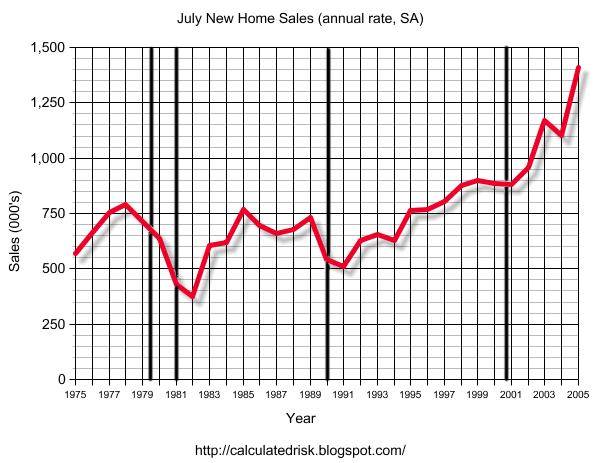
Click on graph for larger image.
The vertical lines indicate the start of a recession.
With the increasing Existing Homes inventory and this very strong New Home Sales report for July, more and more I think this looks like a blow off top for housing. I probably could have written that last year too, but I didn't see the widespread speculation (especially speculation with riskier financing).
I believe there is a relationship between housing, trade and interest rates, and when that starts to unwind, we may see a vicious cycle on the downside.
Tuesday, August 23, 2005
July New Home Sales: 1.41 Million
by Calculated Risk on 8/23/2005 08:10:00 PM
According to a Census Bureau report, New Home Sales in July were at a seasonally adjusted annual rate of 1.41 million vs. market expectations of 1.35 million. June sales were revised down to 1.324 million from 1.374 million.
Click on Graph for larger image.
NOTE: The graph starts at 700 thousand units per month to better show monthly variation.
Sales of new one-family houses in July 2005 were at a seasonally adjusted annual rate of 1,410,000, according to estimates released jointly today by the U.S. Census Bureau and the Department of Housing and Urban Development.
The Not Seasonally Adjusted monthly rate was 120,000 New Homes sold, up from a revised 117,000 in June.
The median sales price of new houses sold in July 2005 was $203,800; the average sales price was $275,000.
The average sales price rebounded slightly and the median price is the lowest since 2003.
The seasonally adjusted estimate of new houses for sale at the end of July was 460,000. This represents a supply of 4.0 months at the current sales rate.
The seasonally adjusted supply of New Homes was 4.0 months, about normal for the last few years.
July was a record for sales, but recently the trend has been for downward revisions and July will probably be revised down. Even though inventories are at a record high, with the strong sales, the months of inventory is normal for the last few years.
Median prices continue to fall and are now at 2003 levels.



