
 RSS Feed
 by Calculated Risk on 8/25/2005 02:46:00 PM
Thursday, August 25, 2005
Krugman: Housing Bubble will Burst
Reuters quotes Dr. Krugman:
"I'll give you a forecast which might very well be wrong, but I think it will burst in the spring of next year," he said at a derivatives conference in Brazil's winter resort of Campos do Jordao.I think it will be sooner rather than later.
"I would be surprised if it doesn't burst in the next three years," he added.
Krugman said skyrocketing U.S. housing prices were supported by large -- and somewhat "odd" -- capital inflows from emerging market countries, such as China, which has accumulated huge holdings of U.S. Treasury debt, helping keep long-term interest rates abnormally low.
"Americans pay for their houses with money they borrowed from the Chinese," he said.
...
An expected decline in U.S. housing investment would be part of an economic adjustment process which could include the weakening of the dollar, higher U.S. exports and the reduction of current account deficits in the world's largest economy, Krugman said.
"This is how we would like to see it happening -- smoothly -- but there are many moving parts and they're unlikely to move at the same time," he said. "So it's not going to happen unpainfully."
Wednesday, August 24, 2005
Housing Thoughts ...
by Calculated Risk on 8/24/2005 11:25:00 PM
Dr. Duy adds some interesting thoughts today: Another Look at Housing.
Like many others, Dr. Setser, Gen'l Glut, Paul Volcker to name a few, Dr. Duy expresses some concerns:
I was unsettled by the combination of weak durable goods numbers, strong housing numbers, and this morning’s Wall Street Journal piece regarding global capital flows into the US housing market. Like many, I see the need for an eventual rebalancing – a shifting away from consumption and housing and toward investment – of growth in the years ahead.Dr. Duy than adds some excellent analysis and graphs. I believe the graph showing the relationship between the CA (Current Account, mostly trade deficit) and housing starts is very interesting. Dr. Duy concludes:
All in all, it suggests to me that international factors – specifically, the willingness of foreign investors to place their capital into the US – have a significant place in explaining the consumption binge/CA deficit/low interest rate issue.The entire post is well worth reading.
...
Of course, the international angle only increases the difficulty of the Fed’s job – the willingness of foreign capital to flow into the US could mean the Fed will end up strangling the non-housing sectors of the economy to keep overall inflation expectations in line.
And on today's numbers, I plotted the New Home Sales for July for the last 30 years (annual rate, seasonally adjusted).
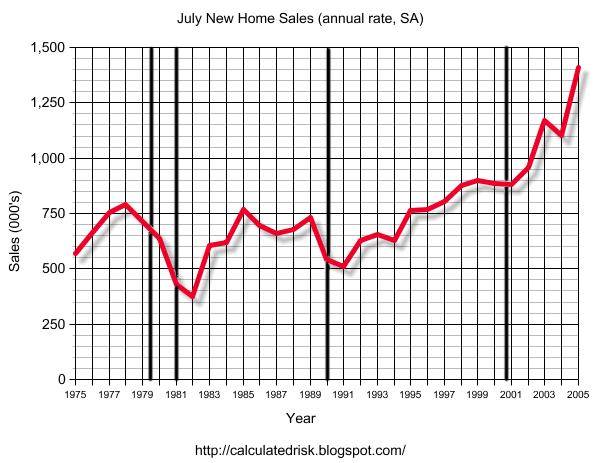
Click on graph for larger image.
The vertical lines indicate the start of a recession.
With the increasing Existing Homes inventory and this very strong New Home Sales report for July, more and more I think this looks like a blow off top for housing. I probably could have written that last year too, but I didn't see the widespread speculation (especially speculation with riskier financing).
I believe there is a relationship between housing, trade and interest rates, and when that starts to unwind, we may see a vicious cycle on the downside.
Tuesday, August 23, 2005
July New Home Sales: 1.41 Million
by Calculated Risk on 8/23/2005 08:10:00 PM
According to a Census Bureau report, New Home Sales in July were at a seasonally adjusted annual rate of 1.41 million vs. market expectations of 1.35 million. June sales were revised down to 1.324 million from 1.374 million.
Click on Graph for larger image.
NOTE: The graph starts at 700 thousand units per month to better show monthly variation.
Sales of new one-family houses in July 2005 were at a seasonally adjusted annual rate of 1,410,000, according to estimates released jointly today by the U.S. Census Bureau and the Department of Housing and Urban Development.
The Not Seasonally Adjusted monthly rate was 120,000 New Homes sold, up from a revised 117,000 in June.
The median sales price of new houses sold in July 2005 was $203,800; the average sales price was $275,000.
The average sales price rebounded slightly and the median price is the lowest since 2003.
The seasonally adjusted estimate of new houses for sale at the end of July was 460,000. This represents a supply of 4.0 months at the current sales rate.
The seasonally adjusted supply of New Homes was 4.0 months, about normal for the last few years.
July was a record for sales, but recently the trend has been for downward revisions and July will probably be revised down. Even though inventories are at a record high, with the strong sales, the months of inventory is normal for the last few years.
Median prices continue to fall and are now at 2003 levels.
Shiller Defines a Bubble and Probable Ending
by Calculated Risk on 8/23/2005 07:41:00 PM
Here are some excerpts from a FoxNews interview with Yale Economist Robert Shiller said:
Shiller admits he doesn’t have a short, simple definition and then goes on to say that defining a bubble "is similar to the way psychiatrists define a mental illness, that is, it involves a list of symptoms."And Shiller expects the end to be ugly:
Indeed, to hear Shiller describe a financial bubble it sounds like a disease. "It’s a social contagion," he says, "An epidemic whose mode of transmission is word of mouth. It’s emotional. People keep hearing about price increases. There’s a tinge of envy about other people who have done well, which brings more and more people into the market. This, in turn, pushes prices up." In other words, it's a self-fulfilling prophecy.
... the most important issue is not whether or when the bubble will burst, but what the "end" will it look like. Shiller confesses he has no idea. He says a lot depends on the other factors or "symptoms" in the mix.
In the extreme scenario, buyers start to default on adjustable-rate mortgages and trigger a financial crisis in the banking sector. Real estate prices nosedive as properties are abandoned. If this is compounded by significantly higher oil prices, "it could change the psychology," says Shiller. "Consumer confidence plummets and people pull back on spending." This causes a downward economic spiral and leads to recession.
In the "soft landing" version, real estate prices simply remain flat for years, much as they did after the boom in the 1970s, until they’re back in line with inflation. "This is what people are counting on happening," says Shiller. He considers this outcome unlikely "because the signs of a bubble are stronger."
Though he admits there are so many variables it’s impossible to forecast it precisely, Shiller says he senses that the housing bubble is "more likely to turn out badly."
July Housing Inventories
by Calculated Risk on 8/23/2005 11:13:00 AM
The National Association of Realtors reports that existing home inventories rose to 2.751 in July from 2.653 million in June. Since sales remained strong (7.16 million units vs. 7.33 million annual rate for June), the months of supply only increased to 4.6 months from 4.3 months in June.
Both numbers were better than I expect (sales were higher, inventory lower). They indicate a return to a more "normal" market and not the end of the housing boom - yet.
Year over year (July '04 to July '05) this is a 12.6% inventory increase.
Update: From Bloomberg:
"We are starting to see more houses coming into the market," and that is a sign of a turn, Harris said. "First you see inventories rising, then you see a flattening of prices and then you start to see people have difficulty selling houses because buyers have more options and they get more demanding."
A total of 2.75 million homes were for sale last month, the most since May 1988.
Bruce Bartlett: Bubble fever
by Calculated Risk on 8/23/2005 01:48:00 AM
Bruce Bartlett, in an article for Townhall.com discusses "Bubble fever". Although Barlett does not take a position, he writes:
Today, many of the same economists who correctly predicted the bursting of the stock market bubble, such as Yale University's Robert Shiller, are saying that the housing market is in a bubble. If it should collapse as the stock market did, the impact could be even more painful. Consider this evidence.
-- Homeowners are much more leveraged than they used to be. According to the Federal Reserve, Americans' home equity has fallen to 56.3 percent of their real estate, from 75 percent a generation ago. Another Federal Reserve study found that 16 percent of the money taken out was simply consumed.
-- According to Freddie Mac, people are taking more and more money out of their homes. Cash-out refinancings have risen to 18.1 percent of all refinancings, from 7.2 percent in 2003. In the last four years, homeowners have taken $559 billion in equity out of their homes.
-- More and more homeowners are buying and refinancing with unconventional loans, such as adjustable-rate and interest-only mortgages, rather than traditional fixed mortgages. Such loans have lower initial payments, but will rise automatically when interest rates rise. The Federal Reserve says that 47 percent of all residential mortgages by dollar volume are now non-traditional.
-- A new study by National City Bank found 53 cities in which home prices were in bubble territory -- defined as 30 percent above where they should be based on local income growth, population density and other factors. Santa Barbara, Calif., ranked as the city with the most overpriced real estate -- 69 percent above fundamental value. Based on the ratio of rent to home prices, prices nationally are now almost 40 percent above where they should be.
-- A new study by the Public Policy Institute of California found growing numbers of homeowners paying as much as 50 percent of their income for housing, including mortgage, taxes, insurance and utilities. In California, 15.4 percent of homeowners fall into this category -- including 20 percent of recent homebuyers -- and 10.6 percent nationally. Almost 40 percent of Californians pay at least 30 percent of their income for housing, with 29 percent doing so nationally. According to Fannie Mae, 28 percent is the most one ought to pay.
According to the National Association of Realtors, 23 percent of homes last year were sold as investments, and another 13 percent were vacation homes. With rapid appreciation being a prime motive for both, any falloff in housing prices could cause many of these properties to be dumped on the market quickly, potentially turning a housing downturn into a crash.
Study: Foreclosures Costly to City
by Calculated Risk on 8/23/2005 12:32:00 AM
The Denver Business Journal reports on a new study by University of Colorado-Denver graduate student Christi Icenogle showing that foreclosed properties are costly to a city. After reviewing the direct costs to the city, the article points out that the combination of "loose" financing and slow appreciation has apparently led to higher foreclosure rates in Denver:
Foreclosure rates have been increasing in Denver, [Zachary Urban, Brothers Redevelopment Inc., a housing counseling nonprofit] said, partly because of adjustable rate mortgages with increasing payments over time, and partly because of job losses. He foresees foreclosures continuing to rise as interest-only loans come home to roost.When housing slows, this could become a widespread problem.
Phil Heter, broker/owner of Arvada-based Heter & Co., said he's also been seeing foreclosures increasing, and thinks it's because of loose qualifications on home financing.
"Most of it is 100 percent financing," said Heter, whose Web site is REODenver.com. With no money down and low appreciation, the owners may have little, no, or negative equity in the house and "have a tendency to walk," he said.
In metro Denver, looking at basic homes for first-time homeowners, Heter estimated appreciation was 1 percent last year, and "that's being generous."
Lower appreciation tends to make foreclosure rates higher because the lack of increase in value makes it tougher to sell the home for more than the amount owed.
A related problem for local governments, discussed at the The Housing Bubble, is that revenues have been increasing rapidly for cities in boom areas. But the local governments are, in the opinion of Scott Ellis, Brevard County, Florida Clerk of Courts:
"... dangerously sinking much of the newfound windfall into recurring expenses, mainly raises and additional employees. When the real estate bubble pops, the tax rolls will march backwards ... there will be weeping and gnashing of teeth by the time next tax year rolls around."When housing slows, it appears costs will be rising and revenues falling for cities and local governments.
Monday, August 22, 2005
Reuters: 40 Year Mortgage "Risky"
by Calculated Risk on 8/22/2005 04:18:00 PM
Reuters reports: Stretching mortgage to 40 years can be risky
"This (40-year) loan product screams of a budget-constrained consumer desperate to get into a home," says Gary Schatsky, a fee-only financial adviser/attorney. "This trend is disturbing to me, especially since it feeds into the growing obsession by consumers to get credit.I think a 40 year fixed rate loan is better than an option ARM. But I do agree that they are symptomatic of desperate "budget-constrained consumer[s]" trying to buy a home.
"They need to think through this mortgage's implications because in many cases, it will become their children's mortgage," says Schatsky, who is based in New York.
... Bankrate.com, notes that interest rates on 40-year mortgages are generally 0.25 to 0.50 percentage point higher than on traditional fixed 30-year loans. That difference negates some of the benefits of the lower monthly payment.Here is an example: A $300K 30 year loan with an average Freddie Mac interest rate of 5.8% has payments of $1,760.26 per month.
For the same amount financed for 40 years with a 0.375% higher rate, the payment is $1,687.38. A buyer has to be desperate to pay the higher interest rate for that small reduction in monthly payments.
"This all stems from affordability and borrowers stretching themselves beyond their reach to get into a home they can't afford," says Economy.com's Chen. "What's next, a 50-year loan?"
Recent anecdotal evidence indicates that home price increases are beginning to decelerate, a sign the housing sector is starting to cool.
"When housing cools, so will these loans," Schatsky says. "If a consumer has to take out this loan to qualify for a home, their goal of homeownership needs to be seriously re-evaluated."
Merrill Lynch: Housing Prices Poised to Decline
by Calculated Risk on 8/22/2005 11:43:00 AM
Reuters reports:
Prices in the hot U.S. housing market are poised to decline as demand dries up due to the inability of first-time buyers to afford a home, a Merrill Lynch analyst said in a research report on Monday.
"The housing market has become so stretched that the affordability ratio for first-time buyers, the folks who drive the incremental demand in the real estate sector, has deteriorated to levels last seen in the third quarter of 1989," wrote David Rosenberg.
The price of an average starter home in the United States has climbed 14 percent over the past year, while the average income for the first-time buyer family has risen just 4 percent, Rosenberg said, calling that an "unprecedented gap."
In the third quarter of 1989, bids evaporated and new home sales dropped 20 percent the following year in response to lofty prices that first-time buyers could not afford, the analyst said.
The inventory of unsold new homes rose to a 8.4 months' supply from 7.1 months' and that inventory buildup led to a 5.8 percent drop in the median price of a new home, he said.
Sunday, August 21, 2005
Sign, Sign, Everywhere a Sign
by Calculated Risk on 8/21/2005 09:06:00 PM
My most recent post is up on Angry Bear: Signs of the Times.
"Sign, sign, everywhere a sign
Blockin' out the scenery, breakin' my mind"
Signs, Five Man Electrical Band
Click on photo for larger image.
Orange County, CA Aug 21, 2005
This photo shows four houses in a row for sale. Two spec houses are being built, the one on the left nearing completion, has a "For Sale by Owner" sign.
For the 3rd and 4th houses, I've blown up the offering signs (upper right corner). The 3rd house is an older home with a For Sale / For lease sign. The last home is a newer resale with a small sign reading "New Listing".
Although three or four listings in a row is rare, a house for sale on every block is common. And when I drove around my neighborhood this morning, there was an open house sign on almost every corner. This may just be a temporary surge in inventories, but it feels like a sea change.



