
 RSS Feed
 by Calculated Risk on 7/05/2005 12:03:00 AM
Tuesday, July 05, 2005
A Unique Conundrum?
The Federal Reserve has been steadily raising rates from a low of 1% to over 3%. And the yield on the Ten Year Treasury stubbornly refuses to budge.
Click on graph for larger image.
That is what happened in the early '60s. The Fed Funds rate moved from 1.1% in July 1961 to 3.5% in late 1963 and the Ten Year yield stayed steady at 4%.
All data from the Federal Reserve.
The yield curve narrowed and then what happened to the economy? It continued to grow and the stock market rallied.
There are many differences from forty years ago and today. But, with the constant drum beat in the financial press about the yield curve, I decided to check if the current situation was unique. It isn't. Nothing profound, I was just curious.
Also, my most recent post is up on Angry Bear: Housing Update.
Saturday, July 02, 2005
Housing: Boston is Looking Peaked
by Calculated Risk on 7/02/2005 12:00:00 AM
Many housing commentators have been looking to the UK and Australia housing markets as leading indicators for the US housing market. Now the housing bust may have reached the US shores: Boston is looking peaked.
In Massachusetts, the number of home sales dropped last month: Mass. home sales plunge 11.1 percent
There were about 36,259 homes on the market last month, or a supply of 8.8 months, a figure generally thought to be favorable to buyers, experts said.That is worth repeating; the supply of existing homes is now 8.8 months in Massachusetts. And that is exactly how many commentators felt the bubble would end:
Economists say this combination - higher prices amid lower sales volume - is precisely what you'd see in a bubble that's dying.And what happens when buyers use excessive leverage and can't sell? Massachusetts Foreclosure Filings Jump As Values Soar
Because of high housing prices, many first-time homebuyers have been using new, risky mortgage products that hold down costs in the early years of a loan, but they can face difficulties if payments rise later. In addition, people who already own homes have been tapping into rising property values to borrow money at historically low interest rates for college tuition, home improvements, credit-card debt, or other financial needs.And finally a quote from Bill Gross from Saturday's New York Times:
"When you tie all these factors together - the bubble in the real estate market, the popularity of interest-only loans, the willingness of lenders to give loans without a significant down payment, the lowering of standards for lenders, and the deep desire of people to own something priced beyond their means - you have a recipe for disaster," said Secretary of State William F. Galvin, whose office oversees the registries of deeds in a majority of the state's 14 counties. "That's what you're seeing in the Land Court."
"... if housing prices stop going up, which would be my forecast, that makes a substantial difference. Individuals have banked on that appreciation every year. You should come to a point where owners of houses realize we're in never-never land and stop buying on a speculative basis. Markets many times fall of their own weight. That's what happened with the Nasdaq in 2000."And maybe that's what is happening in Boston. Should we sound the alarm? The British Bust is coming!
Friday, July 01, 2005
Wells Fargo: Decade of Flat Home Prices
by Calculated Risk on 7/01/2005 01:19:00 AM
The Orange County Register reports on a presentation by Wells Fargo's chief economist Scott Anderson at the Westin South Coast Plaza on Wednesday. The Register quotes Anderson:
"We're talking about a decade at least – if not more – of (housing price) stagnation,"
"There will be a slow fizzle (in prices), not a pop,"Still Anderson is fairly positive:
There's a little oomph left in the market, he said. Anderson predicts that 30-year, fixed mortgage rates will remain around 5.8 percent over the next six months, which could help boost home prices about 5 percent this year. Next year, homeowners might see a 1 percent to 2 percent increase in appreciation, then Anderson expects prices will level off indefinitely until incomes can catch up.Previous housing booms also fizzled. But ten years of nominal price stagnation would be a 30% decline in real terms.
Even though much of Orange County's economic recovery can be attributed to the housing boom, Anderson doesn't think stagnant housing prices spell recession, because strength will remain in other sectors like technology and tourism.
I'm less confident than Mr. Anderson about avoiding a recession.
Thursday, June 30, 2005
CNN Newsnight: Aaron Brown Discusses the Housing Bubble
by Calculated Risk on 6/30/2005 11:37:00 PM
On Tuesday night, CNN's Newsnight with Aaron Brown had a segment on the housing bubble. Here are excerpts from the transcript:
BROWN: Back in the mid '90s, when we were all thinking of early retirement after our Internet stocks tacked on another 10 or 15 points, there were naysayers who said it wouldn't last, who said rationality always returns eventually, who said it was a bubble and a dangerous one at that. Oh, those naysayers.There is more, but that was the most in-depth part of the discussion. Dean Baker didn't get much face time!
By the way, are you counting on home equity to fund your retirement? Like the fact that your home doubled in the last decade or so? Feeling rich again? So is this deja vu with a mortgage? Here's CNN's Andy Serwer.
(BEGIN VIDEOTAPE)
ANDY SERWER, CNN CORRESPONDENT (voice-over): Is there a housing bubble? It depends who you ask and where you ask.
DEAN BAKER, CTR FOR ECONOMIC POLICY RESEARCH: Well, there's absolutely a housing bubble. In the last seven or eight years, we've seen an unprecedented run-up in home prices nationwide.
SERWER: No question, certain markets are red hot. Since 2000, the price of a single family home has jumped 77 percent in New York City, 92 percent in Miami, and 105 percent in San Diego. And there are other signs besides just home prices, 86 books on real estate investing were published last year, nearly three times as many as 1998.
Speculators have added fuel to overheated markets. In Los Angeles, for example, the number of homes sold that have been owned for less than six months jumped 47 percent in a year.
Prices are so high in some areas that renting a home has become dirt cheap by comparison. In San Francisco, for example, rent on a median price house runs $1,532 a month. Owning the same house with a typical mortgage would cost $3,424 a month.
But not every market is on fire. Some experts say that bubbles are mostly in cities on the east and west coasts. If those bubbles were to burst, it would shock the entire economy. But some say prices won't collapse, they'll just ease up.
FRANK NOTHAFT, CHIEF ECONOMIST, FREDDIE MAC: As long as the local economy remains strong and there is good job creation, then we're not going to see a drop in home values.
SERWER: In cities such as Dallas or Salt Lake or Pittsburgh, prices haven't risen nearly so much. Radical differences in prices can make moving from a hot zone like LA to a colder one like Syracuse either a windfall or a slap in the face, depending on which way you're going.
So what does all this mean for the prospective buyer?
FRANK NOTHAFT: It's a very personal decision whether or not they should sell now and choose to rent. If you're happy with your home and you enjoy the home that you're in and the neighborhood you're in, there's no point to sell it right now and switch to renting.
SERWER: In other words, don't just buy a home because you think you'll make a ton of money on it in two years. And don't sell your home just because it's appreciated wildly either. Because in real estate, as in everything else in life, you can't count on getting a better deal down the road.
Andy Serwer, CNN, New York.
(END VIDEOTAPE)
BROWN: Taking the global view for a moment, globalization being the rage these days, in 2004, housing prices in Spain and France went up even faster than they did here in the United States, 15 percent up for the year. Compared to 9 percent nationwide in the U.S.
But before you bet the farm, or the house, consider this. In Japan, house prices have dropped for the last 14 years. And they are now down 40 percent from their peak back in 1991. Here at home again, the median price of a house is $207,000. That means half the houses cost more, half the houses cost less.
Any economic topic is difficult for TV News. No pictures. I can imagine the viewers reaching for the remote ... hmmm, any shark attacks today?
Real Estate "Summit" Comments
by Calculated Risk on 6/30/2005 09:21:00 PM
Following are some comments and stories from the Reuters Real Estate Summit in New York.
Property guru says U.S. market nearing peak Peter Korpacz, the head of real estate business advisory services for PriceWaterhouseCoopers told reporters:
"The thing the industry is focusing on now is jobs growth. For the most part its running at about 175,000 a month. It's a healthy economy, but it's not robust. During this point in the last recovery (in the early 1990s) jobs were growing at about 217,000 a month."Toll Bros sees possible correction in hot markets
Korpacz said real estate lenders and developers are far more disciplined now than in the past and so there was little threat to the market from speculative development, although the red-hot residential sector was giving rise to concerns among investors.
He added that if there is a major drop in prices for condos or single-family housing, it could hurt "real estate as a whole and just wash (away) the whole industry."
"In the hot markets, I wouldn't be surprised to see a 20 percent decline," [Robert Toll Brothers Inc.'s chief executive] said at the Reuters Real Estate Summit in New York. "You've got a price going from $1 million to $800,000, I don't have a problem with that.For more stories see the Reuters Summit site.
"I don't think you're going to have a pop, which means I don't think you've got a bubble," added the head of the luxury home builder at the summit held at Reuters U.S. headquarters in New York. "But I do think you're going to have a correction as the markets unnaturally overheat because of speculation."
Environmental Economics
by Calculated Risk on 6/30/2005 01:31:00 PM
An an undergrad, I was incredibly fortunate to take Chemistry from Drs.Sherwood Rowland and Mario Molina. At that time, the future Nobel Laureates (1995 Nobel Prize in Chemistry) Rowland and Molina were working on their ground breaking discoveries into how chlorofluorocarbons (CFCs) were impacting the ozone.
But Rowland and Molina's work was just the start. To correct the CFC caused ozone depletion problem it took a combination of great science, an open discussion of the environmental impact of various policy options, government action and international cooperation. Not only was the chemistry fascinating, but that was my introduction into market failures and externalities. When I spoke with Dr. Rowland a few months ago, he modestly told me the science might have been the easy part!
With that prelude, here is a new Environmental Economics blog with 17 contributing economists addressing many of the economic and political issues that are required to transform good science into good policy. Enjoy!
Britain: Headed for a Hard Landing?
by Calculated Risk on 6/30/2005 11:16:00 AM
According to MSNBC:
The Bank of England's attempt to bring Britain's highflying economy in for a soft landing is starting to reach the nail-biting stage.Of course less consumer spending is also related to the deflating housing bubble:
Fears are growing, even within the BOE, that consumer spending is faltering in response to past hikes in interest rates and soaring energy bills.
At the center of the drama is Britain's housing bubble, which began to lose air in the second half of last year. Although the growth rate of house prices has slowed sharply, a generally healthy economy has helped to allay worries over a collapse. Now the economic outlook is dimming.Housing slows, consumers retrench, and then the job market starts to soften:
In particular, consumers are pulling back more than anticipated.
The newest concern is the labor markets. In May the number of workers claiming jobless benefits rose for the fourth month in a row. That hasn't happened since 1993, and it could be a harbinger of softer job markets. Wage growth, excluding bonuses, is already slowing.And the next step in the downward vicious cycle? Falling housing prices, followed by even less consumer spending and more job losses and then a further reduction in house prices ...
Bloomberg columnist Matthew Lynn offers a similar view: U.K. Consumers Risk Recession With New Restraint.
The U.K. consumer shows every sign of having run out of steam and the economy is teetering as a result.The US has also had a "huge increase in household debt". Perhaps Britain's problems offer a glimpse of the future for the US housing market and economy.
British shoppers have become hypersensitive since the Bank of England increased interest rates five times from November 2003 through August 2004, and since their household debt skyrocketed to more than 1 trillion pounds ($1.82 trillion).
There may well be a lesson in that for policy makers in many other countries. Consumers who have piled up debt are far more responsive to rate changes than previously.
What used to be just a nudge on the interest-rate rudder is now sending the economy downhill. The U.K.'s growth rate has fallen in each of the past four quarters.
``The main factor has been the huge increase in household debt,'' said Stuart Thomson, a fixed-income strategist at Charles Stanley Sutherlands in Edinburgh, in a telephone interview. ``It is the highest in the developed world. So people are really getting squeezed as rates rise.''
UPDATE: Another take on UK: Economic growth weakest in 2 years
And the GDP data suggest an even greater link between the housing market and consumer spending than the BoE at first assumed, suggesting worse could be yet to come.
The saving ratio in 2004 fell to its lowest since 1963 as household spending was credited with making an even greater contribution to the economy over the last few years, before slowing in line with the housing market.
The Nationwide building society said house prices fell 0.2 percent in June, bringing the annual rate of increase to a nine-year low of 4.1 percent, compared with nearly 20 percent a year earlier.
"This obviously increases the danger that the saving ratio will rise over the coming quarters as the housing market weakens, slowing the growth of household spending even further," said Jonathan Loynes, chief economist at Capital Economics.
Tuesday, June 28, 2005
Housing: FDIC and California
by Calculated Risk on 6/28/2005 07:57:00 PM
According to the article in the previous post:
Today, the agency will release new state-by-state economic profiles. Taken together, the profiles conclude that most booming U.S. housing markets are sustained by strong growth in new jobs.Here is the California profile and two graphs.
"In general, that is where home prices are rising most rapidly," said Barbara Ryan, associate director of the FDIC's research division.

Click on graph for larger image.
Job growth in the bay area and southern California trailed the rest of the Nation.
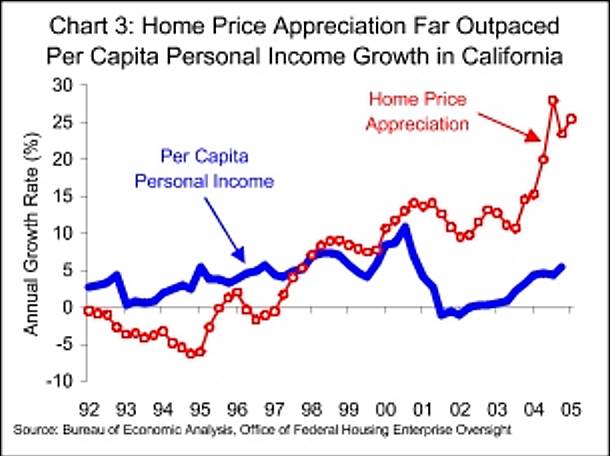
Price appreciation outpaced income growth.
The data for California does not seem to support the FDIC's conclusion.
Sec. Snow and FDIC: No Housing Bubble
by Calculated Risk on 6/28/2005 07:04:00 PM
Treasury Secretary Snow appeared on CNBC today. According to FOX:
"I think in some markets housing prices have risen out of alignment with underlying earnings," Snow said. But also answering the question whether there was a housing bubble in the United States his answer was a flat-out "no."And officials at the FDIC apparently believe that housing prices are the result of strong job growth. From this article:
Top officials at the Federal Deposit Insurance Corp. (FDIC), which regulates national banks, yesterday dismissed fears that rising home prices nationwide reflect a speculative bubble ready to burst.Here are the FDIC State Profiles.
...
Today, the agency will release new state-by-state economic profiles. Taken together, the profiles conclude that most booming U.S. housing markets are sustained by strong growth in new jobs.
"In general, that is where home prices are rising most rapidly," said Barbara Ryan, associate director of the FDIC's research division.
Snow also commented on Oil prices:
"Energy prices are way too high," Snow said on CNBC television. "Clearly, it's hurting."Don't worry, be happy!
"Clearly, energy prices serve as a tax, they reduce the disposable income available to do other things and they take some oxygen out of the economy," Snow said. "Energy is my concern. I think energy is the biggest concern," he added.
But Snow said the U.S. economy is currently managing to withstand the "headwinds" of oil at $60 a barrel. When asked if these energy prices portend a recession, Snow said: "No. I don't see it derailing the strong recovery we're in ... but it does take a few tenths of a (percentage) point off GDP growth, that's for sure."
Monday, June 27, 2005
BIS: US Urged to Act First on Global Imbalances
by Calculated Risk on 6/27/2005 10:44:00 PM
From the Financial Times, the Bank for International Settlements (BIS) warned Monday that "growing domestic and international debt has created the conditions for global economic and financial crises".
UPDATE: Macroblog links to the BIS report with key excerpts.
The Basel-based organisation's annual report said no one could predict if and when such international economic imbalances would unravel but "time might well be running out".The BIS urged the US to act first:
"Given the size of the [US] government deficit, the obvious first step would be to cut expenditures and raise taxes"...The report then turned pessimistic.
Without a smaller budget deficit, lower private sector consumption and higher savings, there was little likelihood of stabilising the ballooning US current account deficit. The ever widening deficit “could eventually lead to a disorderly decline of the dollar, associated turmoil in other financial markets, and even recession."
...the BIS report questioned the Bush administration's willingness to impose the required policies to back up its deficit reduction ambition ..."Time is running out" and no action will be taken "in the near term". How sad.
"If what needs to be done to resolve external imbalances is reasonably clear, it also seems clear that much of it is simply not going to happen in the near term."



